A Church “Out of This World”
One recent study of over 3,500 incoming freshmen at various universities who identified themselves as “born again” Christians found that by their senior year, between one third and one half said they no longer considered themselves such. If a person is willing to change his position on being a born-again Christian, how much more is willing to give up regarding his views and practices relating to the church?
- Dan Smithwick
It is of little surprise to pastors, Christian educators and parents that a high percentage of young people stop attending church after leaving home. Whether it's off to college or off to work, the church doesn't seem to fit the schedule of most young adults, even from Christian homes.
One recent study of over 3,500 incoming freshmen at various universities who identified themselves as “born again” Christians found that by their senior year, between one third and one half said they no longer considered themselves such. If a person is willing to change his position on being a born-again Christian, how much more is willing to give up regarding his views and practices relating to the church?
Throughout Scripture we find numerous warnings not to depart from the Faith. Consider the following:
This book of the law shall not depart from your mouth, but you shall meditate on it day and night, so that you may be careful to do according to all that is written in it; for then you will make your way prosperous, and then you will have success. (Jos. 1:8)
Now then, my sons, listen to me, and do not depart from the words of my mouth. (Prov. 5:7)
Train up a child in the way he should go. Even when he is old, he will not depart from it. (Prov. 22:6)
Undoubtedly, these words of Scripture have been spoken frequently by pastors, teachers and parents, and have been heard by our young people. Yet many have departed. Why?
I believe the answer to this is largely due to the lack of relevance of the church and the Christian Faith, as seen by young people. While the church was the dominant force in building our nation (founding universities and hospitals, producing scholarly statesmen who drafted state constitutions and later the federal constitution, creating charitable organizations to care for the poor and widows, etc.), today the church has been pushed (or has voluntarily retreated) back into a non-defining role for how society should live. The agenda for today's public square is clearly shaped by secular and anti- Christian forces, not the church.
In essence, the church has left the world. Contrary to the first-century church and the Reformation-era church, the twentieth-century church has abandoned a Biblical world and life view. The church as a whole offers only a personalized and pietistic religion.
The message received by young people is one of how to get to heaven when they die (something which none are thinking about!), but not how to live in full obedience to Christ while on earth. With no comprehensive philosophy of life being offered in most churches, it's little wonder that young people find the church irrelevant.
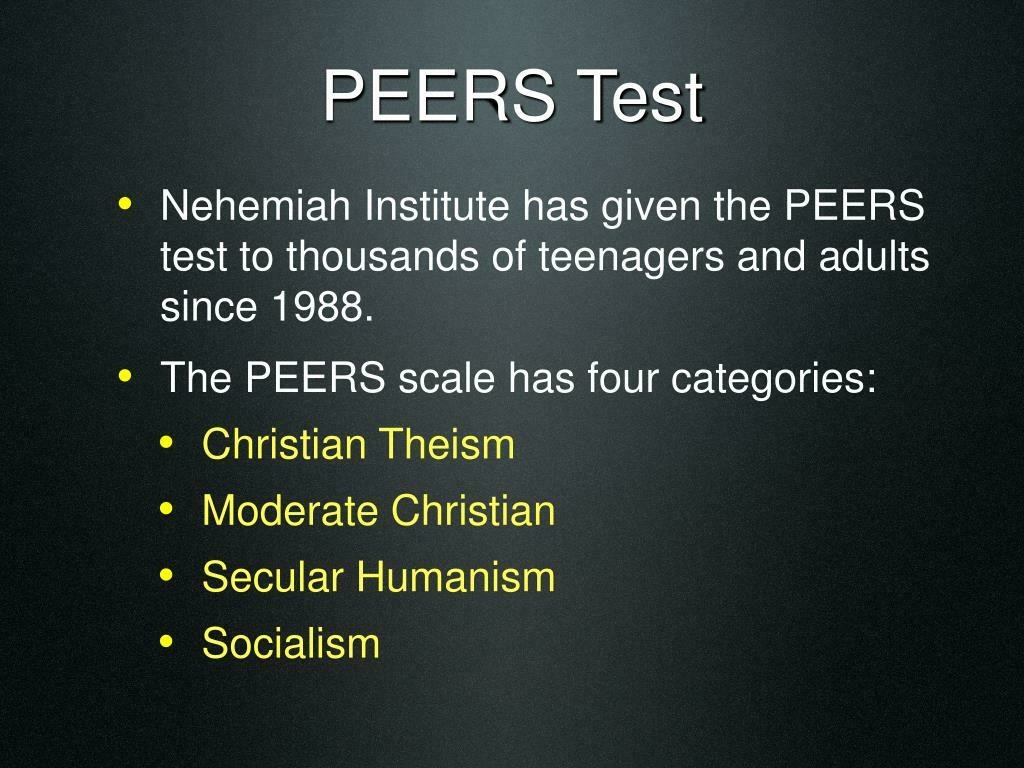
The Nehemiah Institute is taking direct aim at this problem. In 1986 the Institute began developing a means for Christians, and Christian organizations, to identify their understanding of the Biblical worldview. The program developed and marketed nationally is called PEERS Testing. It identifies an individual's worldview from far-left liberalism (Socialism) to a mature conservative. Christian worldview in five key areas: Politics (civil government). Economics, Education, Religion and Social Issues (P.E.E.R.S.).
During the beta-test period, 1988-94, the test was administered to several hundred individuals, including students (in both public and private schools), teachers, pastors, ministry leaders, homemakers, government employees. New Age adherents and others. The results showed both a weak understanding of Christian worldview understanding, especially among youth, and an alarming decline over the seven-year period. Only in Principle Approach and Classical Christian schools were students showing good scores and improving year by year.
Listed below are responses from some of the test questions which were found among students in traditional Christian schools:
Agree
- The ideal government guarantees the citizens a minimum income, social security, unemployment compensation, health insurance and housing. 77.2%
- Moral values are subjective and personal. They are the right of each individual. Individuals should be allowed to conduct life as they choose as long as they do not interfere with the lives of others. 75.4%
- In social, economic, cultural and political affairs, people should have equal rights. Social reform should, therefore, be designed to correct existing inequalities and to equalize the conditions of nurture, schooling, residence, employment, recreation and income that produce them. 84.2%
- One of the most effective ways of curbing inflation, if not eliminating it all together, is imposing wage and price controls. 80.7%
- Day-care schools for infants and toddlers, under the supervision of professional educators, will enhance the educational process of children and will produce more well-developed and productive citizens. 73.7%
Note: These results are based on responses from students with composite test scores of 25.0 or less on a scale of -100 to + 100. The average score for students from traditional Christian high schools in the 1994/95 school year was 28.2. In contrast, the average score for several well-known Christian ministry leaders was approximately 90.
I believe PEERS results give evidence of why our young people are departing from the church. Rather than the church, the state is viewed as the official body for deciding “how then shall mankind live.”
To aid in correcting low scores, the Nehemiah Institute has now developed a course suited for high school age and above. The course is entitled. Developing a Biblical Worldview. It is designed to run approximately 20 weeks at 1-2 hours per week.
The course includes the PEERS Test, a Teacher Guide, a 120- page Student Workbook, and various other aids to give basic instruction in the five areas covered in PEERS Testing. Developing a Biblical Worldview is well suited for Bible classes in Christian schools, church youth groups, and for parents and children at home. For a free “snapshot” view of the course, call 1-800-948-3101.
As the bearer of truth, the church must “return to the world,” to fulfill its mandate of redemption in all areas of life. Developing a Biblical Worldview is a definite start in that direction.

- Dan Smithwick
Dan Smithwick is President of Nehemiah Institute. The institute is a research and educational private foundation providing worldview testing and training materials to Christian educators. He has been guest speaker on several Christian radio shows. He is married and has five childen. He can be contacted at [email protected].