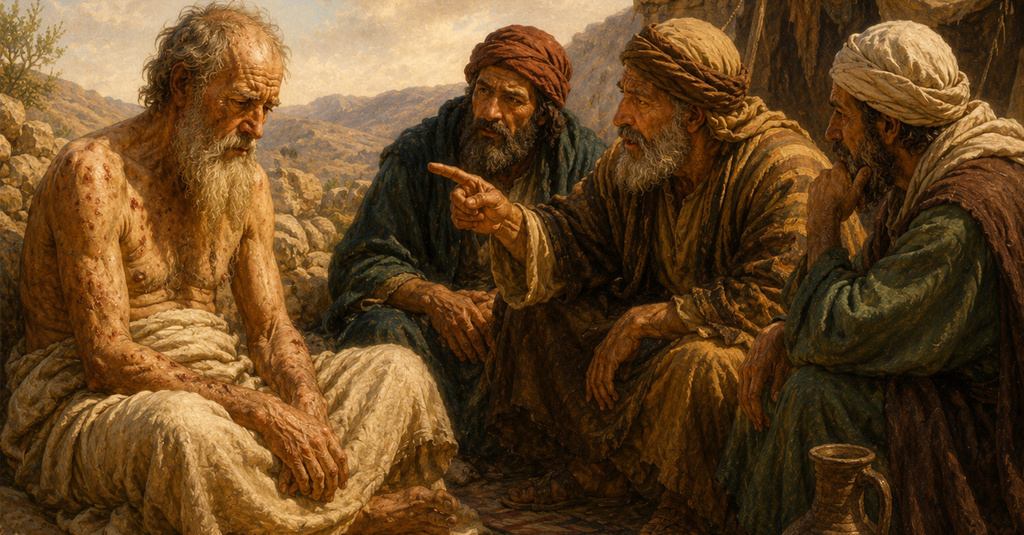
“Physicians of No Value”
Job called his friends “physicians of no value,” and we ourselves are awash in physicians of no value in every sector of our society, starting with the individual.

- Martin G. Selbrede
In Job 13:4 we encounter Job’s indictments of his friends’ attempts to comfort him. After accusing them of manufacturing falsehoods, he adds that they are “physicians of no value.” It will be our object in this discussion to show that Job wasn’t the only one who had to deal with physicians of no value. We are awash in physicians of no value in every sector of our society. While we will start with personal application, we’ll see that the term suits the situation on much larger scales, where its full impact is felt.
The Personal Dimension
The phrase “physicians of no value” occurs in the context of Job’s comforters speaking to him. The counsel received was so harmful that Job declared that silence would have ministered to him better than their ill-considered words (Job. 13:5).
We need to contrast Job’s comforters with the biblical standard for words of comfort. I’ve condensed the following discussion from my Foreword to the upcoming Journal of Christian Liberty1 to set the stage.
The Lord God hath given me the tongue of the learned, that I should know how to speak a word in season to him that is weary (Isa. 50:4a, KJV)
The Lord God has given Me the tongue of disciples, So that I may know how to sustain the weary one with a word. (Isa. 50:4a, NASB)
The first thing to note is that the tongue is literally “a disciple’s tongue.”2 You will know you’re dealing with a disciple’s tongue by the healing effects of its output. The second half of the verse refers to having the “ear of a disciple,” meaning both to listen to and also to obey the Word of God. We would only expect the effect (words that heal) from the cause (resting on the Word in all respects). As Oswalt explains it, “The Servant is able to speak God’s word to the broken and outcast of the world because he has learned from the outset of the day to do what his Master tells him to do.”3
What does this tongue bring to the situation? “The tongue—the object of which is comfort to the weary. Not to astonish, dazzle, bewilder, but to edify and console.”4 The word used appears only here in the entire Bible, and means either “to help with words” or to “sustain” using “words [to] encourage those who bear heavy burdens.”5
The power of the tongue to sustain is directed toward the weary. “To know the word that sustains the weary is ‘to know how to sustain the weary with a word.’”6 The purpose is “to sustain by a word him that is weary.”7 Who are the weary? Young points out the connection of Isaiah 50 with Isaiah 42 to establish that “the weary are the bruised reed and the smoking flax.”8
The words commended by the prophet are more especially those spoken to the weary; but Scripture connects a very wide meaning with that term. It includes (1) him that is weary with the overtoil of life; (2) him that is weary of the commonness and comparative meanness of labor; (3) him that is weary through the perplexities and difficulties of life; (4) him that is weary through prolonged bearing of pain; (5) him that is weary in well-doing; and (6) him that is weary of the strife with sin.9
Christ’s example here is the standard by which all speech is to be measured. We hence have no excuse for failing to distinguish between beneficial and harmful speech.
If you prefer the rendering “a word in season” in lieu of “words that sustain” in Isaiah 50:4, that doesn’t let anyone off the hook either:
Words are “out of season” when they are (1) unadapted; (2) untimely. They are always out of season when they find expression for pride of self rather than for care of others.10
Consequently, we are without excuse for continuing to exacerbate the wounds suffered by His people with our empty platitudes and casual cliches. Compounding the people’s wounds by “putting forth the finger” (Isa. 58:9) “and speaking vanity” (also Isa. 58:9), is regarded as a perversion of His intentions, for the goal (Isa. 58:10) is to “satisfy the afflicted soul.”
The Critical Wider Application
Clearly, the “physicians of no value” that Job declared his friends to be fell far short of meeting the criteria just laid out from Isaiah 50:4 above. When we extend the discussion to larger frames of reference (family, city, nation, world), the incompetence of our physicians becomes even more evident.
Whether for individuals or nations, there are three key aspects of a physician’s work that jointly form the frame and ligaments of his profession: he must diagnose the situation before him correctly, determine the cause accurately, and then treat it accordingly. A correct diagnosis avails little if no proper treatment is forthcoming: this too marks the physician of no value. And even a correct diagnosis is of no value if the cause is misunderstood: the treatment will misfire.
We have to be concerned with diagnosis (what disease are we dealing with), the cause that gave rise to that condition, and the treatment (not mere symptomatic relief). And between secularists and compromised Christians, an immense amount of energy has gone into crafting false diagnoses, alleging incorrect causes, and directing huge resources that usually worsen the original condition.
Dr. Rushdoony saw this exemplified in economics, where the failure of modern economic policy is routinely laid at the feet of the people due to their failure to believe in the new economics. Their outdated beliefs (creating bank runs) are the problem. The fault is never with the planners.
We’ll be sharing observations from a hitherto unpublished book by Dr. Rushdoony being released by Chalcedon at the end of 2026 titled Subversive Man. Though written in 1965, its insights provide an unmatched foundation for understanding which physicians are of no value, and which to trust.
False diagnoses can proceed from outside of the faith as well as from inside the nominal church. We see Christ counseling the Laodiceans to apply eye salve to reverse the deadly blindness afflicting them. Blindness to the truth is inherently damaging; such blindness is total for a compromised man:
He fails to see that he himself is a part of the monstrous evil of the age, a force for subversion by his flagrant disregard of the Christian roots of his culture. Apart from that orthodox Christian faith, he too is another humanist, a sentimental humanist, whereas the Marxist is simply an unsentimental one.11
Rushdoony points out how the blindness inflicted by refusing the truth can grow to catastrophic proportions, using imperial Rome as one example.
The Roman civil government had itself left Rome to escape the welfare mobs it had created, but it could not escape the consequences of its contempt of truth. And, as the barbarians destroyed it, Rome’s contempt of truth made it blind to its own destruction.12
There being nothing new under the sun, a similar declension from truth has overshadowed men who live in the world of today as well. Rushdoony doesn’t hesitate to identify the guilty.
In the contemporary world, the seminaries must bear a major responsibility for the widespread flight from truth. Instead of resisting humanism, scientism, and socialism, the seminaries have extensively made these demonic concepts their new gospel, and their guilt is in proportion to their responsibility.13
Following that path, we’ll begin with looking at false diagnoses emanating from both church and state.
The Doctrine of Selective Depravity
Dr. Rushdoony’s descriptions from 1976 give us the broad outlines of this false but popular doctrine. All three sections of Dr. Rushdoony’s analysis can be consulted on a single page at Chalcedon’s website, from which the following three paragraphs are taken.14
The doctrine of selective depravity is a doctrine of radical Pharisaism. By isolating depravity in a particular class, race, or group, it implicitly locates virtue in all others, particularly in the defining group. If evil is a national or racial trait, then membership in the other group, whether black, white, red or yellow, Anglo-Saxon, Arab, Japanese, or whatever it may be, constitutes virtue. All “facts” are collected to prove the point: we are the good guys, they are the bad guys.
The doctrine of selective depravity ensures conflict, not against sin, but between man and man, class and class. It has made humanism the most divisive creed ever to exist, and it leads to the isolation and “alienation” of man.
The doctrine of selective depravity is basic to modern politics, education, sociology, and, too often, our religions. As long as this doctrine prevails, and it is deeply imbedded into modern man’s being, no solutions are possible. In fact, every “solution” only aggravates the problem.
Even AI summaries get this concept right, pointing out that this false doctrine is a key element of political messianism, which Christians ought to oppose. Wherever we find this doctrine, we find statism growing in malignancy.
For Christians to follow the humanists into this ditch underscores a tragic parallel in Scripture: the physicians of no value in Job 13:4 are grammatical cousins to the shepherds of no value in Zech 11:17 (the KJV reading of “idol shepherd” is actually “shepherd of no value”).
Even More Bad Diagnoses
Rushdoony finds even more sources of blindness afflicting modern man beginning with his addiction to myth, and his reordering of reality in terms of his myths.
Few periods in world history since Christ have been more dominated by myth than the present one. Modern man lives and moves and has his being in myths. These myths are particularly effective in their appeal to man because they ostensibly exalt him. … The myth of an era … is its criterion for judging and assessing reality, so that reality is seen only in terms of the prevailing myth.15
Humanism then views morality through this distorted lens. We see in Rushdoony’s 1965 assessment the very thing dominating our news cycles: the infallibility of man’s feelings, which are honored at all costs.
Morally, the humanistic order rebels at the idea of conformity to the word of God and substitutes conformity to the word or feelings of man. An ethics of love is then the ethics of human emotions, and it is inevitably a situation-ethics geared not to God’s infallible word but to man’s infallible feelings.16
Given this emphasis, modern man shifts evil away from the moral plane to a metaphysical plane. By this gambit, he condemns the truth of Biblical Christianity as a vicious insult to man.
Since plenary man has been made the alternative to the plenary God, evil cannot be ascribed to man. It is ascribed instead to his world, and man’s problem is seen as an evil and hostile environment. Since sin and evil are not in man but in his environment, the regeneration of man is not only unnecessary but offensive. The modernist is militantly hostile to the idea of personal, spiritual regeneration, because it is an affront to his religious faith in man. … If man is not what he should be, it is because a hostile and uncongenial world has been imposed on him by God and other men.17
Therefore, the diagnosis of modern man concerning his estate can never point to the actual source of his misery, but involves massive blame shifting paralleling that indulged in by Adam and Eve in Genesis 3.
For the modernist, because his sovereign is not God but man, it is the world which has failed man.18
These faulty diagnoses then extend deep roots into the growth of the state as the correct treatment for man’s problems as humanism sees it.
The state, when seen as the highest collective expression of autonomous man rather than God’s ministry of justice, will function as if it has a soteriological purpose: its calling will be to save man from all of his problems, from crime, poverty, sickness and disease, death, hunger, war, and all things else. … The mission is not then the spiritual regeneration of man by God, but rather the material re-creation of man’s environments by the state. Man is then not regenerated but re-educated into looking not to his heart for responsibility for sin, but to the state, for responsibility to rescue him from an evil environment. The modernist sees man is in bondage, not because of his sin, but because of Christianity and capitalism.19
Dr. Rushdoony readily marshals evidence from actual physicians that reverses all previous assessments of mankind’s most invidious evils, putting the blame instead on those who dare to speak out against the evil.
The second Kinsey report defended child molesters as persons who make a significant contribution to the sexual and social development of a child. Any damage done is by moralists who condition the child against such experiences. The erosive power of evolutionary thinking is total. Linked to education, and together to socialism, the result is a force for revolution unequaled in all history.20
We turn now to root causes for mankind’s ills as misidentified by the self-appointed physicians of humanism.
The False Search for Root Causes
Modern man has taken note of the scattering that was feared at Babel in Genesis 11, and believes he has fabricated a more effective defense against the God Who would dare to author another scattering of man.
This is the evil to man in the Society of Satan, disunity, not apostasy nor rebellion against God. Again, the import is theological. It is a philosophical and theological necessity that there be no disunity in the godhead; hence, if man be our god, he cannot be divided; he must be one.21
So fundamental is this drive to unity, to lockstep conformity and forced compliance, that any attempts to subvert humanism’s centralizing force is deemed immoral on its face.
Evil is that which opposes this total unity and this non-discriminatory faith. This non-discriminatory principle always works in favor of evil in that it forbids truth and justice in favor of unity. Its champions are in the modernist clergy.22
By resetting the calibration on its moral compass, these assessments by man pave the way to impose the solutions it has intuited in its rebellion against the Creator God who governs.
False Remedies and Missteps
Dr. Rushdoony makes clear that men must prepare for ideological battle. Few are preparing for it, making themselves a prey.
[Anarchism, Marxism, etc.] cannot be met by a sterile syncretism and eclecticism. They cannot be fought by men with minimal beliefs who pick and choose a few nosegays from various systems and religions in terms of their tastes and rebel at the requirement of systematic thought and dedicated submission.23
This would be bad enough if it were merely that we need to train the faithful more thoroughly, but the reality is that too many enemies of Christianity come from within its ranks.
The subversion of Christendom has come as surely from the children of Christendom as from its enemies. Until that realization begins to arouse men from their slumbers, the resistance will be ineffectual.24
A major element in humanism’s solution to man’s problems is the complete rewriting of moral theory in terms divorced from all absolutes.
The essential position of man must be, not an insistence on truth, which is divisive, but on dialogue, which means an appreciation of the position of other religions and moralities and an exchange of ideas with a merging of ideas.25
Therefore, morality now serves a different master, the state. Rushdoony identifies John Dewey as a primary architect of this reorientation.
Morality for John Dewey was instrumental or pragmatic to social ends; morality thus was restored to its ancient, pre-Christian status as social cement: the function of morality in this view is to keep people subservient to the aims and purpose of the state.26
Liberty was then defined in terms divorced from scripture as truth itself fell in the street (see Isa. 59:14). This paved the way for the cancerous growth of the power state.
[For the progressivists] it is immutable truth which is totalitarian, and relativism which is alone free. … In terms of this perspective, God and truth mean totalitarianism, and man’s freedom rests in total absorption into the life of the state.27
While our readers will recognize tyranny lurking in these formulations, be aware that humanism flips that charge back on men of faith.
[Harvey Cox writes:] “Secularization signifies the removal of religious and metaphysical supports and putting man on his own. It is opening the doors of the playpen and turning man loose in an open universe.” The God of orthodox Christianity must be discarded. The existentialist Camus “quietly insisted that man must choose between the tyrant God of Christian theology and being a full man.”28
The appeal of Camus is cynical: be a man, defy the God of Scripture. Humanists invite us to begin the demolition process for them.
Rushdoony even quotes a major church policy document that exults that the time is coming when “man is finally forced to see that God is to be known only as he works in history – in the secular.” To which Rushdoony replies, “In other words, the proper goal of Christianity is its own suicide! Anyone who can believe that the goal of the Bible is to proclaim the death of Biblical faith and the death of the Biblical God can believe anything.”29
True Diagnoses
Dr. Rushdoony illuminates the path to honest assessment of our social ills with much-needed candor.
Without the communist threat, our society would still be very sick, and possibly even sicker. America has been severed from its Christian roots and made relativistic.30
The handling of guilt is a significant index of the health of a society. Rushdoony drew attention to this in commenting on the core meaning of the evasions hatched by Adam and Eve in the garden.
Guilt thus is transferred. It is projected on the environment, made part of the ultimate frame of things, passed on to others, evaded by transference and projection. Guilt is denied to the individual in the name of social and natural forces.31
In contrast to this, the Biblical model tends in a different direction entirely.
… instead of transference of guilt, it is the essence of Biblical faith to confess it, declaring with David that sin is primarily and essentially an offense against God.32
Additionally, the question of authority is subject to dislocation when Christianity deteriorates and humanism, with its tyranny of the experts, gains the upper hand. Recall the measures put in place to handle the COVID-19 matter. Note how this dynamic appears in 1965 when Rushdoony quoted Diana Spearman that “submission to the demands of experts for only half-comprehended reasons makes people willing to accept orders, legislation, or policy of any popularly elected government.”33 This tyranny of the experts grows as standards of accessible truth erode.
With this destruction of standards which are given by God (and made comprehensible to every man), there is also an insistence that new, man-made standards are alone valid.34
Many remember being told, “Trust the science,” which soon found incarnation in the words “I am the science.”
These polite (but coercion-laden) bromides have leaked into politics as well. Dr. Rushdoony describes a prevailing malignancy that continues to be cynically recycled.
The idea that “Legislators represent people” is only true when the people are more powerful than the state; then the legislators respond to the power of the people and represent the people in their defense of their liberties. But when the state has become as powerful as the modern state is, the legislators represent the state, not the people, because they ally themselves to its power.35
Correct Delineation of Causes
John Taylor Gatto’s book, Dumbing Us Down, warrants a new edition tracing the great intellectual fall of Christian ministry. The collapse was easily noticed in 1965 when Rushdoony cited a particularly damning source:
Mark A. May, in his study of The Profession of the Ministry, found that “Presumably the educational level of the Protestant ministry in the United States in 1926 was below that of 100 years ago and well below that of 200 years ago.” This decline began at about the same time as the seminaries began to assume their responsibilities, but both seminaries and the decline had a common cause.36
Further, the doctrine of Christ had suffered dangerous decay – dangerous because of humanism’s zeal to exploit the alleged vacancy left on the throne of the King.
[Modernism’s] most logical and necessary result is always the de-divinizing of Jesus Christ, who is regarded simply as a man. But the de-divinizing of Christ goes hand in hand with the re-divinizing of the state.37
American seminaries, almost all dedicated either to a planned or a planning society, are thus able ministers of the religion of Caesar rather than of Jesus Christ. In the name of Christ, they proclaim Caesar. In the name of the church they build the re-divinized state. The few seminaries which dissent from this rampant gospel of statism are almost all simply champions of the older Pietism and evangelism rather than the older and clearly theocentric faith.38
With Christless Christianity rising to compete with the faith once delivered, the primary fruit of communion in Christ disappears. Community is rendered impossible to maintain.
The so-called “new society” of socialism has been able to gain power but it has been unable to establish community, to create a society. And community or society is a necessary and God-given condition of man’s life. Without community, life becomes hell, and the meaning of hell is the total absence of community or society, … The essence of true society is Christian community. Its restoration and fulfillment is the inescapable God-ordained requirement and direction of history.39
As an aside, note that Christians who persist in putting hope in the government schools have failed to take the reason for their existence seriously.
If it is to be true to itself, the statist school can only teach statism; it cannot teach liberty from statism without being treasonable to itself.40
The Road to Healing
Dr. Rushdoony, who identifies centralization as a primary component of subversion, shows that all answers that entail centralized power are anti-Christian and doomed to fail.
Man is stronger to the extent that his transcendental faith and his local roots grow and flourish; he is weak when he becomes faithless and rootless. The man of faith who values his local heritage is best prepared to respect the heritage of another man.41
Jer. 17:5 teaches that “cursed is the man that trusts in man, that makes flesh his arm.” Statism is that arm of flesh on steroids.
To call for a trust in man is to imply a required trust in man’s order, the state. Orthodox Christianity, with its distrust of man, distrusts every human institution, including the church and the state. All are under the judgment of God and the standard of His word.42
In parallel with this is Rushdoony’s rejection of man’s focus on power:
John Cotton in the Massachusetts Bay Colony, with his faith in limited power and limited liberty, both under God, was able to give his thought a great scope of influence and power precisely because he did not aim at power but recognized the limitations of both power and thought and their relationship under God. Contemporary mythology to the contrary, faith has given thought its high and proper place, whereas modern society, with its power-worship, sees thought only in an instrumental sense, as a means to power over man and nature. The modern intellectual who plays at being god is not thereby asserting the values of intelligence but rather the primacy of power and his contempt of scholarship.43
Here is where Rushdoony shows the path forward. It is the man who operates in terms of absolutes that will have an impact on the future.
[Humanists] are ultimately flexible, because they are relativistic. There is for them no transcendental truth. For us as Christians, there are certain things that are unchanging, unshakable, and there are certain things we are forbidden to do. Therefore there is a rigidity to our position, which is its strength.44
You do not have the basis for a resistance to any other political creed, to any subversive force, unless you have first and foremost a transcendental law that says differences are basic, transcendental, of kind, not of degree.45
Men too often put their faith in the wrong physicians, and Christians aren’t exempt from this problem. It is time to reverse the trends that have led back to the perpetual kindergarten.46 Rushdoony saw how difficult things were in 1965, and his counsel then is no less crucial for us:
A major problem today is not how to win the battle but how to maintain what is left. Where can Christian schools have teachers trained? Where can professional or graduate training be received which will prepare men in terms of Christian liberty and scholarship? No such base exists. There is a need for a “maverick” institution, wearing no man’s brand and unbroken in its dedication to principle.47
The scope of healing48 will ultimately grow beyond our ability to imagine it. But our part to play in that process involves putting aside the physicians of no value and to continue to build in the midst of our enemies with God’s Spirit driving us forward.
The fact that Dr. Rushdoony’s diagnoses from six decades ago continue to hit the mark today, while other men fumble about, certainly tends to commend him as one of our physicians of high value.
1. Journal of Christian Liberty: Symposium on Abuse (Vallecito, CA: Chalcedon/Ross House Books, 2026), vol. 1, nos. 1 & 2, 36-38.
2. J. Alec Motyer, The Prophecy of Isaiah (Downers Grove, IL: IVP Academic, 1993), 399.
3. John N. Oswalt, The Book of Isaiah, Chapters 40–66 (Grand Rapids, MI: Eerdmans, 1998), 324.
4. E. Johnson in The Pulpit Commentary, eds. Spence and Exell, Vol. 10: Isaiah (Grand Rapids, MI: Eerdmans, n.d.), §2, 250.
5. Peter A. Steveson, A Commentary on Isaiah (Greenville, SC: BJU Press, 2003), 432n7.
6. Motyer, ibid.
7. W. Kay in The Bible Commentary, ed. F. C. Cook (Grand Rapids, MI: Baker Book House), vol. 5, 258.
8. Edward J. Young, The Book of Isaiah: Volume 3, Chapters 40–66 (Grand Rapids, MI: Eerdmans, 1972), 298.
9. W. Clarkson in The Pulpit Commentary, op. cit., §2, 253.
10. R. Tuck in The Pulpit Commentary, op. cit., §2, 255.
11. R. J. Rushdoony, Subversive Man (Vallecito, CA: Chalcedon/Ross House Books, 2026), 7.
12. Subversive Man, 159.
13. Subversive Man, 159.
14. https://chalcedon.edu/resources/articles/doctrine-of-selective-depravity-parts-i-iii
15. Subversive Man, 105.
16. Subversive Man, 108.
17. Subversive Man, 109.
18. Subversive Man, 110.
19. Subversive Man, 111-112.
20. Subversive Man, 125.
21. Subversive Man, 86.
22. Subversive Man, 86.
23. Subversive Man, 6.
24. Subversive Man, 7.
25. Subversive Man, 157.
26. Subversive Man, 166.
27. Subversive Man, 169.
28. Subversive Man, 183.
29. Subversive Man, 197.
30. Subversive Man, 72.
31. Subversive Man, 78.
32. Subversive Man, 79.
33. Subversive Man, 100.
34. Subversive Man, 100.
35. Subversive Man, 177.
36. Subversive Man, 151.
37. Subversive Man, 158.
38. Subversive Man, 158.
39. Subversive Man, 128.
40. Subversive Man, 170.
41. Subversive Man, 38.
42. Subversive Man, 38.
43. Subversive Man, 57.
44. Subversive Man, 89.
45. Subversive Man, 102.
46. https://chalcedon.edu/resources/articles/the-perpetual-kindergarten
47. Subversive Man, 69.
48. https://chalcedon.edu/resources/articles/the-scope-of-healing
- Martin G. Selbrede
Martin is the senior researcher for Chalcedon’s ongoing work of Christian scholarship, along with being the senior editor for Chalcedon’s publications, Arise & Build and The Chalcedon Report. He is considered a foremost expert in the thinking of R.J. Rushdoony. A sought-after speaker, Martin travels extensively and lectures on behalf of Christian Reconstruction and the Chalcedon Foundation. He is also an accomplished musician and composer.