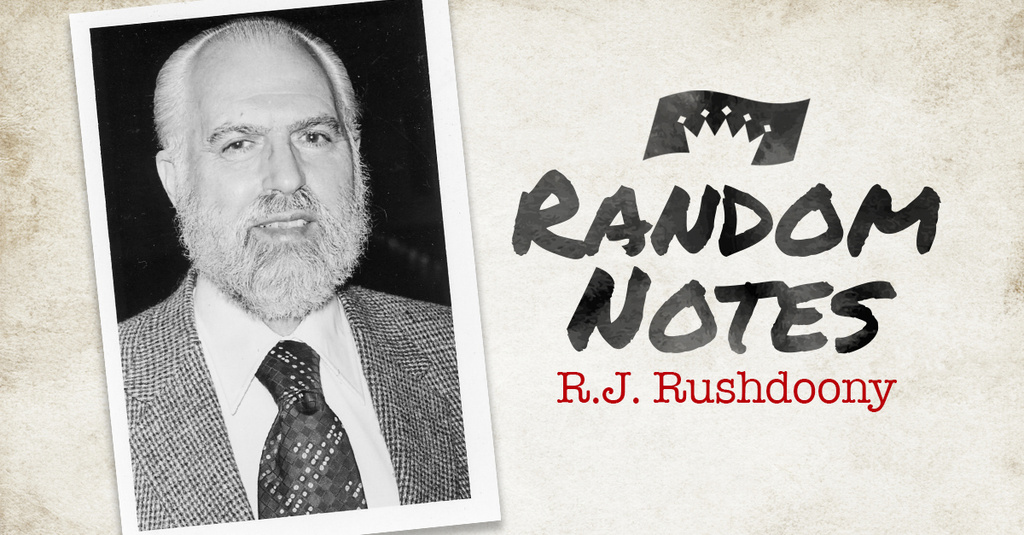
Random Notes, 60
Some years ago, when I was still young, a member of a then prominent family told me to make note of a man's career. He was, briefly, very prominent and a potential “mover and shaker.” He was a good man in that he reflected a Christian training but not the Faith. I was told that, because of his bold strategy, he probably would die suddenly, which was the case. This politician became aware of this danger, and he disintegrated morally before his death.
- R. J. Rushdoony
1. Some years ago, when I was still young, a member of a then prominent family told me to make note of a man's career. He was, briefly, very prominent and a potential “mover and shaker.” He was a good man in that he reflected a Christian training but not the Faith. I was told that, because of his bold strategy, he probably would die suddenly, which was the case. This politician became aware of this danger, and he disintegrated morally before his death.
Wrong though it is, people kill for their Faith, and man's Faith has been too long political. The Faith can change from church to state salvation, but the urge to “settle” matters with death remains with such men, who trust more in evil than in good.
Again, the man who died became, in his last months, greedy for something he had not concerned himself with previously, illicit sex. Facing the threat of death, he was suddenly very hungry for “life,” which to him was now sex.
I have since forgotten the man's name, but not the meaning of the matter. What we truly live for reveals itself. Also, if our “solutions” are evil ones, then we are evil also.
2. The Christian Challenge (January-February 1996, p. 11) has a report on “Church Stranger than Fiction.” One item is less offensive than others and more amusing. “A musician from St. John the Divine gets 200 Episcopalians at an environmental meeting howling at the moon to show their oneness with the wolf.” But did they do it properly, naked and all fours?
3. M. Mitchell Waldrop, in Man-Made Minds: The Promise of Artificial Intelligence (1987), speaks of computers as a revolution comparable to printing. He has a careful account of the remarkable things now appearing. He warns us, however, that printing did not solve the problem, nor achieve a universal enlightenment (p. 193). He concludes thus: “Some four thousand years stand between us and the author of Genesis. Technology has changed the world immeasurably in that time. And yet we can still read his words and feel their power. I somehow doubt that the advent of intelligent machines is going to change that very much. These machines may transform the world in ways we can only guess at—but we will still be human” (p. 250).
4. I loved my years as a university student. Very early, I had “stack” privileges, so I was in the heart of the library, reading and studying. What did distress me was the emphasis on critical thought. I could understand analytical thought, but critical thought always has seemed to be arrogance in my estimation. To take a simple example, to ask students to critique something by Shakespeare or Milton is to train them into a silly self-importance. Books are routinely written about great writers and scholars as exercises in criticism rather than analysis. I hold this is ungodly and disrespectful.
5. A problem which has always troubled me is my mail. I receive many excellent and gracious letters, but who can answer carton boxes of mail? Very reluctantly, I am giving up here. Although my health is good, at 80 I know that my time is growing limited, and there is so much writing I still want to do and so this is my priority now.
6. One of the startling contradictions of the French Revolution (to which Lord Acton called attention), was its belief that religion and cruelty are identical. This belief was advanced alongside the Reign of Terror, which was held to be a sanitary measure and therefore a good one. Mankind has never more deceived itself than in the name of revolution. Acton also noted, “A draft project of the Rights of Man had appeared, in which the writer avowed that, by the law of nature, a man may do what he likes in the pursuit of happiness, and, to elude oppression, may oppress, imprison, and destroy” (The French Revolution, p. 113).
7. I read yesterday a disturbing article by a very successful pastor on the way to be a successful pastor. He did everything possible to keep members happy, active, influential in the direction of church activities and the nature of the preaching, and so on. Much was said about pleasing the people, nothing about pleasing God and giving the people a God-centered focus. No wonder we are in trouble.
8. Do you remember when, perhaps 20 years or so ago, a major news story was about how some branch of the national defense establishment bought ordinary hammers for $99 each? Well, now a recent audit of the books of the U.S. Bureau of Indian Affairs showed the mishandling of $2.4 billion in American Indian trust funds. Also, the bureau's financial managers had valued three ordinary chain saws at $99 million each (U.S. News & World Report, February 26, 1996, p. 23). Not much attention was given to this. Has corruption become so commonplace that such things no longer matter?
9. Some of the women were laughing after a meeting over a story that is worth passing on. It seems, the story so tells it, that a long faithful husband took a mistress and spent much time with her. A puzzled friend asked him, “What does she have or do for you that your wife doesn't?” The man answered, “She cooks with butter!”
10. Many years ago, all the way through grade school, teachers were very insistent that the legally correct abbreviation for California was Calif., never Cal, let alone CA., which could be mistaken for Col. or Co., i.e., Colorado.
But who now says Ca. is correct but Washington, D.C.! For me, it is still wrong!
11. We are very grateful to all of you who responded to Andrew Sandlin's appeal for funds. Usually, the holiday season, from Thanksgiving through Christmas and New Year's, is when c. 40% of our income reaches us. This year, on December 31, we were a little more than $102,000 short. Because of your response, we are correcting that shortfall.
12. A serious error on the part of many is to look back to “the good old days.” This kind of thinking reflects the pagan idea of a golden age at the dawn of history, whereas the Bible tells us that we are working in Christ to overcome the Fall. True, there have been some good eras, partially blessed times, but history is really a struggle against sin. In the best of times, there have been very evil men.
Consider Alberigo, the tyrant of Treviso, c. 1250. Although none had offended him, Alberigo had the 25 civic leaders of Treviso hung in a single day in a way to prolong their torture. They had done no wrong, but Alberigo feared good men. Thirty women, their wives, daughters, and sisters, were brought forward; their clothing cut off from the breasts down, and they were lined up in front of the dying men and then compelled to walk between the kicking legs of the dying men. The weeping, praying women were then banished. They struggled on their way, and reaching Venice, sought help from the Cardinal, Lord Ottavio. A crusade succeeded, the people treated Alberigo as he had treated others, and his family received the same brutal treatment.
Ah, the good old days! As for me, I want God's law order, which will in due time come.
13. In his Commentary on Genesis, John Calvin wrote on sin, “Moreover, since it is a disease inherent in the human race, willingly to attempt to deceive God by some fictitious pretext, let us know that we do nothing effectually, until we tear up our sin by the roots, and thoroughly devote ourselves to God.”
14. The artist Edgar Degas was one of several artists of his day who did not marry in order to devote himself totally to his art. In his old age, he tole Ambroise Vollar, “A man should marry. You don't know what the solitude of old age is like.” According to Nancy Plain, in Mary Cassatt, An Artist's Life, when old and blind and no longer able to paint. Degas wandered through the streets of Paris, “He even took to following funeral processions as they wound their way to the graveyard. He seemed to long for death” (p. 150).
- R. J. Rushdoony
Rev. R.J. Rushdoony (1916–2001), was a leading theologian, church/state expert, and author of numerous works on the application of Biblical law to society. He started the Chalcedon Foundation in 1965. His Institutes of Biblical Law (1973) began the contemporary theonomy movement which posits the validity of Biblical law as God’s standard of obedience for all. He therefore saw God’s law as the basis of the modern Christian response to the cultural decline, one he attributed to the church’s false view of God’s law being opposed to His grace. This broad Christian response he described as “Christian Reconstruction.” He is credited with igniting the modern Christian school and homeschooling movements in the mid to late 20th century. He also traveled extensively lecturing and serving as an expert witness in numerous court cases regarding religious liberty. Many ministry and educational efforts that continue today, took their philosophical and Biblical roots from his lectures and books.