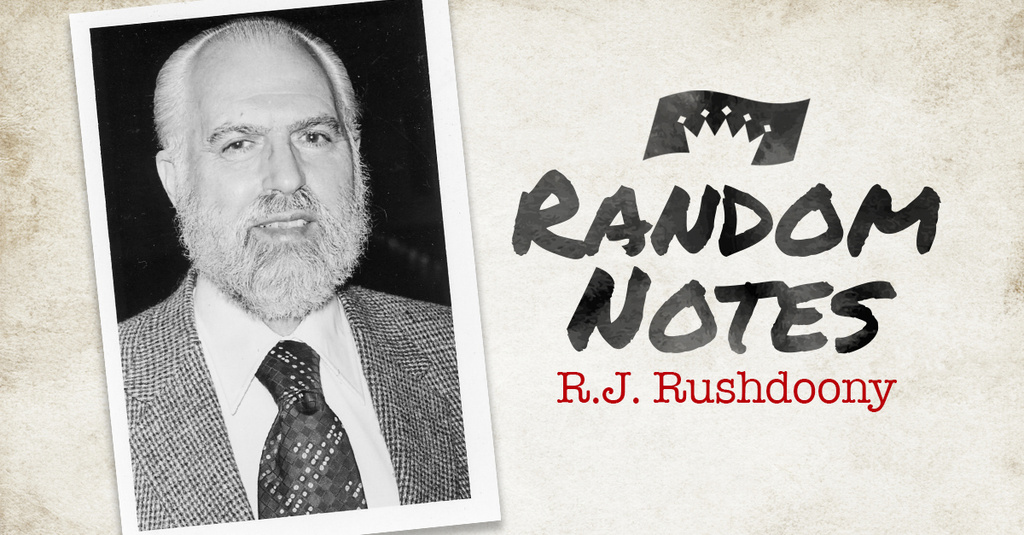
Random Notes, 61
1. A book I enjoyed recently was Oldrich J . Blazicek’s Baroque Art in Bohemia (1968). If the art Blazicek reports on was in a major Western European country, it would be better known. We tend to associate great works of art with the great powers, a false equation. One sentence I wish the author had expanded on was this: “The artistic style was determined by the task to be achieved, the expression of ruthless power, and was therefore massive and austere, its language still Italian, yet concentrated in Prague” (p.14). In time, in one area after another, “the art degenerated from grandeur to prettiness” (p. 143).
- R. J. Rushdoony
1. A book I enjoyed recently was Oldrich J . Blazicek’s Baroque Art in Bohemia (1968). If the art Blazicek reports on was in a major Western European country, it would be better known. We tend to associate great works of art with the great powers, a false equation. One sentence I wish the author had expanded on was this: “The artistic style was determined by the task to be achieved, the expression of ruthless power, and was therefore massive and austere, its language still Italian, yet concentrated in Prague” (p.14). In time, in one area after another, “the art degenerated from grandeur to prettiness” (p. 143).
2. In California, when grazing lands are converted to orchards or vineyards, steel shanks are thrust into the soil as much as eight feet to loosen the soil for planting purposes. Now the U.S. Army Corp. of Engineers has accused John Teresi of Lodi of the “crime” of endangering underground wetlands! The purpose of the “ripping” is to break up clay and hardpan, and loosen the soil, a real plus. Now the U.S. wants to make it a crime (Stockton Record, Tuesday, February 27, 1996, p. 1A and 8).
3. I like the story about the dedicated lawyer whose wife insisted that, without further delay, he tell their son “the facts of life.” Reluctantly, the father did so, and this is how he began: “Son, your mother thinks it is time you were told the alleged facts of life.”
I also enjoyed a cartoon showing Eve telling Adam as they were expelled from the Garden of Eden, “I still think we could have gotten a better deal if we had plea bargained.”
4. I have, over the years, believed increasingly that in recent centuries art has been cursed with the ideal of greatness, it turns the artist, whatever his field, into a pretentious person writing for the critics and the literati, while professing to despise them both. Homer, whatever profundities the scholars ascribe to him, was simply a veteran story-teller. He enjoyed telling a story and knew how to do it well.
One consequence of our present trend is that it is killing off the arts. Poetry has become unreadable, novels pseudo- Bibles, paintings a flight from meaning, and so on and on.
5. According to Katie Roiphe, in The Morning After: Sex, Fear, and Feminism on Campus (1993), “For men in feminism, there is an assumption by feminism on campus of guilt. The original sin is being born a man” (p. 136). Is it any wonder we are in trouble?
6. Lying about the past is commonplace with doctrinaire historians. Then, sometimes, the truth is told. Robert C. Solomon, in The Bully Culture: Enlightenment, Romanticism, and the Transcendental Pretense 1750- 1850 (1979, 1993), wrote, “Feudalism had been all but dead in France since Louis XIV; the peasants were as well off as any in Europe, owning 40 percent of the land in France outright, and had relatively free access to most of the rest of it” (p. 95). With the French Revolution, taxes went up.
Solomon said of Marx, that his “basic thesis, therefore, is this: the more we have the less we are” (p. 335). The solution? Save man by stripping him of his possessions! Jean-Jaques Rousseau had a like opinion before Marx, holding that, when property was abolished, there would be no selfishness (p. 61). No wonder Horace Walpole, on meeting the French philosophers, observed, “Overbearing and fanatic: they preach incessantly” (p. 21).
Voltaire said, “I am tired of hearing how only twelve men established the Christian church; I want to show that only one can destroy it.” (p. 35).
Solomon observed, “Incest seems to have been an unspoken Enlightenment custom” (p. 274). It certainly was a Renaissance custom.
Of Napoleon, Solomon wrote that he cheated at cards, had a bad temper, and was self-righteous. He would allow no man to bring a mistress to court, and he refused to meet Talleyrand’s wife because they had slept together prior to marriage. Napoleon gave birth to a “self-righteously terrifying world” (p. 171). Our century has deep roots.
7. Preachers have done the strangest things. Did you know that Bourbon whiskey was first distilled by a Baptist preacher, the Rev. Elijah Craig, in Georgetown, Bourbon County, Kentucky, in 1789. The Baptists have played a varied role in American history! I wish I knew more about Elijah Craig, and what his theology was!
Root beer, by the way, was an American Indian invention. They made it out of real roots.
8. A Common aspect of small-town American life, before World War II and television, was the barn-storming troupes of actors, staging plays in tents in one town after another. The great favorite for years was Harriet Beecher Stowe’s Uncle Tom’s Cabin. At one time, there were about 500 troupes of tent-show actors across the U.S. Of course, a variety of other plays were performed, comedies, dramas, and farces.
A major attraction in those years at mid-week church meetings was the “magic lantern show,” i.e., slides depicting a variety of things such as foreign missionary work. Very popular also were pictorial re-tellings of John Bunyan’s Pilgrim’s Progress, with someone retelling the familiar story with each slide.
All this was not too long ago, but what a different world it was then! In my lifetime, I have seen the change from kerosene lamps to electric lights, and from outdoor to indoor plumbing, I can remember when electricity came in, and hearing an old farmer, a neighbor, remark about the electric poles as they went in, that it was “a beautiful sight.” It is a statement I shall never forget. To him and to others, it means a marvelous progress and a better life. He was not contemptuous of the advantages it brought him. Now we are all complainers, and we live amid a soured generation and society, among people who are rich but feel poor.
9. Did you know that one of the earlier uses of zippers was by what was then called a “hootchie-kootchie” dancer. Little Egypt, at the 1893 Chicago World’s Fair? She needed something that would make quick changes possible. However, then and for years later, zippers were not too secure, so they took years to catch on, World War II, to be exact. Silly little facts like this amuse me.
- R. J. Rushdoony
Rev. R.J. Rushdoony (1916–2001), was a leading theologian, church/state expert, and author of numerous works on the application of Biblical law to society. He started the Chalcedon Foundation in 1965. His Institutes of Biblical Law (1973) began the contemporary theonomy movement which posits the validity of Biblical law as God’s standard of obedience for all. He therefore saw God’s law as the basis of the modern Christian response to the cultural decline, one he attributed to the church’s false view of God’s law being opposed to His grace. This broad Christian response he described as “Christian Reconstruction.” He is credited with igniting the modern Christian school and homeschooling movements in the mid to late 20th century. He also traveled extensively lecturing and serving as an expert witness in numerous court cases regarding religious liberty. Many ministry and educational efforts that continue today, took their philosophical and Biblical roots from his lectures and books.