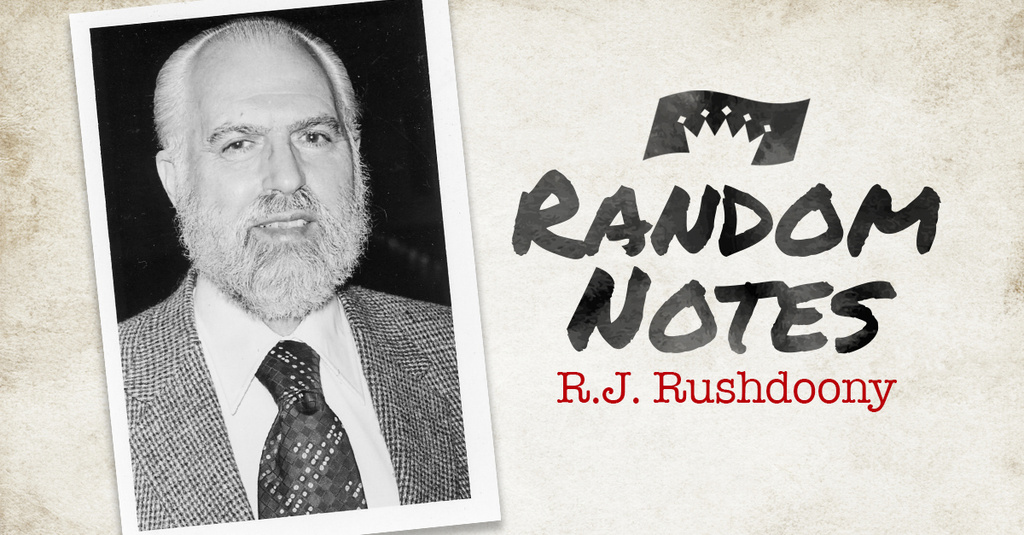
Random Notes, 63b
1. Something reminded me recently of a saying or proverb used by my mother when I was quite young. If anyone walked through the kitchen near dinner time, he or she might be drafted to the old wood stove, if not to get more wood, then to stir something. Her saying was, “Everything needs to be stirred or turned over on a stove except water.” So, you stirred, while she took care of something else.
- R. J. Rushdoony
1. Something reminded me recently of a saying or proverb used by my mother when I was quite young. If anyone walked through the kitchen near dinner time, he or she might be drafted to the old wood stove, if not to get more wood, then to stir something. Her saying was, “Everything needs to be stirred or turned over on a stove except water.” So, you stirred, while she took care of something else.
2. In the latter Middle Ages in England, the Biblical view of property as belonging to the family, past, present, and future was very strong. “An estate (and, therefore, a kingdom) was not so much the property of an individual as a sacred family trust to be handed down from generation to generation and, if possible, increased” ( J . R. Landers: The Limitations of English Monarchy in the Latter Middle Ages, 6.1986).
Judges etc. who were men of little property were not popular with the people because they were commonly guilty of extortion (pp. 31f., 36).
3. Every year, U.S. & World Report has a rating of the top colleges, universities, law schools, etc. in the United States. Their criteria are mechanical and superficial. Too often, law schools, for example, that rank high are unfit places for intelligent and moral students. Guest speakers, invited by the school or its student body, are commonly jeered and their lectures disrupted by barbarian students, with never a dissent from the presiding professor. This tells us that neither students nor faculties have any regard for law, or are capable of civilized behavior.
4. An otherwise excellent book I read recently described America as an undefiled and pristine wilderness before the coming of the white man. This is silly, and it is nonsense. The Indians set fire to drive game towards them, but even this was nothing compared to the damage done by buffalo, for example. Many herds, 100,000 each, moved across the land destroying all the trees and vegetation before them. Had not the white man come, in time all forests from coast to coast would have been destroyed by the buffalo. in a “nature” film on coyotes in the Los Angeles city limits, the narrator said cities had taken over the coyote’s habitat, and hence his presence in cities, eating cats and dogs, and even attacking children. This is not true. The coyote was a minor presence in the West before the coming of the white man; now he is in all 48 mainland states in great numbers. He is in the cities because, like most animals, he goes where the food is, something the cautious mountain lion is now also doing. The easy food is in the cities. Probably more wild animals are in the cities than we yet know about.
5. A rule my father established when we were young, and maintained as long as he and my mother lived, was that we, my brother, sister, and I, write home at least once a week, if only a postcard, whenever we were away, and when we married and lived elsewhere.
6. Here are some interesting items from Yankee Ingenuity by Harry Harris (1990). Herbert Hoover, the secretary of commerce, in 1922 predicted, “The American people will never stand for advertising on the air.” But on August 28, 1922, the first commercial aired, and it was ten minutes long (p. 83)!
Fortune cookies were an American invention for Chinese restaurants. One of the early “classics” was, “Eat, eat, you need strength to worry.” Another was, “Smile—people will wonder what you are up to” (p. 131).
Naval lieutenant Matthew Fontaine (1806-1872) was a maverick, challenging naval teachings and traditions. He was injured in a stagecoach accident, so the Navy happily put the Virginian in the depot for naval charts and instruments. Midst the dust, Fontaine found thousands of logbooks. With his staff, he collected the data to record weather observations of various kinds. By 1851, he issued information on all the world’s major seas. He also discovered the Northwest Passage by studying reports on the migration of whales. Fontaine’s work became the basis of international charts. Dr. Wallace Humes Carothers made the first wholly man-made fiber. Nylon. But he never lived to profit by it. Depressed by his sister’s death, and convinced that he was a failure, he committed suicide in 1937.
One more item: parking meters were first tried out in Oklahoma City, Oklahoma on July 16, 1935. The public reaction was so violent that the National Guard was called out to restore order. Another try was made in Mobile, Alabama, where ax-toting unreconstructed Southerners destroyed the meters.
7. You hear and read much about the bad old days When men ruled their wives for better or for worse. Did you know that in the 1800s when a woman committed a crime it was her husband who served time? In England, when a family went into debt, the man went to debtor’s prison. (Warren Farrell: The Myth of Male Power, 92, 237.)
8. John Peter Rumrich, in A Matter of Glory: A New Preface to Paradise Lost (1987), commented on ancient Hebrew culture thus: “ If we can detect any aristocracy in Israel, it is an aristocracy of the righteous—those who obey the law” (p. 37).
- R. J. Rushdoony
Rev. R.J. Rushdoony (1916–2001), was a leading theologian, church/state expert, and author of numerous works on the application of Biblical law to society. He started the Chalcedon Foundation in 1965. His Institutes of Biblical Law (1973) began the contemporary theonomy movement which posits the validity of Biblical law as God’s standard of obedience for all. He therefore saw God’s law as the basis of the modern Christian response to the cultural decline, one he attributed to the church’s false view of God’s law being opposed to His grace. This broad Christian response he described as “Christian Reconstruction.” He is credited with igniting the modern Christian school and homeschooling movements in the mid to late 20th century. He also traveled extensively lecturing and serving as an expert witness in numerous court cases regarding religious liberty. Many ministry and educational efforts that continue today, took their philosophical and Biblical roots from his lectures and books.