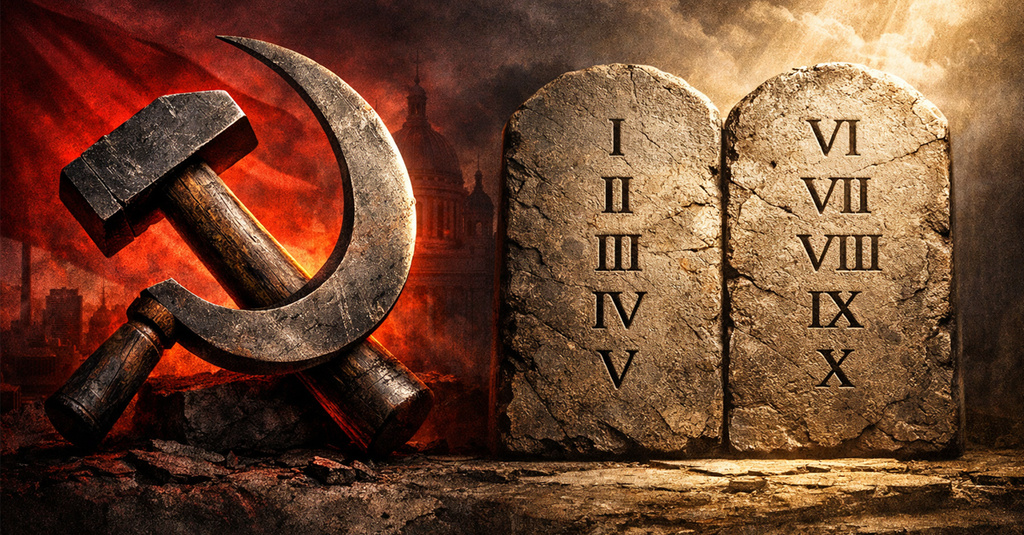
Socialism or Christian Reconstruction: Two Forms of Dominion
As debates over socialism, statism, economics, education, and the future of American culture escalate, Christians are once again faced with a fundamental question: What vision of dominion will define the next generation?

- Chalcedon Editorial
As debates over socialism, statism, economics, education, and the future of American culture escalate, Christians are once again faced with a fundamental question: What vision of dominion will define the next generation?
Dominion is an inescapable concept, and to ignore it only means one will suffer under the dominion of the wicked regardless of its political form. At some point, we may run out of enough years for the last days prophecy teachers to continue putting forward the hope of a rapture, and Christians will start to realize it’s either Christian Reconstruction or some version of the city of man.
In the recent episode of the Chalcedon Podcast, host Andrea Schwartz sat down with Mark Rushdoony and Martin Selbrede to explore how Christian Reconstruction provides the only enduring, moral alternative to the utopian promises of socialism. Their discussion was more than a policy critique—it shined a light on the foundational differences between two forms of dominion, and the necessary steps Christians must take to rebuild civilization from the ground up.
Once again, Chalcedon is putting forth a clarion call: Christian Reconstruction is not a theological niche. It is the antidote to the cultural and moral collapse of the modern age. It’s not enough to comfortably critique socialism when what’s needed are the building plans and practical steps toward godly dominion.
Socialism’s Continued Appeal and Why Ignorance Is Fueling It
The discussion began with a question many Americans are now asking: Why is socialism still gaining ground in a nation that once rejected it outright? What’s the appeal?
Mark Rushdoony pointed to a broad cultural amnesia, “There’s a greater degree of ignorance about what socialism is. Marxism has a negative connotation… but a lot of people think of socialism as much more benign.” What people don’t realize, he continued, is that “there’s more similarity between socialism and Marxism than there are differences.”
This ignorance isn’t limited to secular circles. Even Christians, Mark explained, have become susceptible to a diluted understanding of economics and history. The false allure of socialism—particularly its “democratic” varieties—rests on a widespread desire for quick fixes: “People want a quick fix and they don’t want to listen to the basic historical, economic, and even moral argument against these systems.”
Yet the most important distinction is not economic but moral—and theological. That’s why Christian Reconstruction and socialism are not merely competing political philosophies; they represent opposite visions of what man is and how society changes.
Mark summarized the contrast simply, “Christian Reconstruction is a ground-up change… God changes individuals who then change their families, their businesses, their communities—really all of society.”
Socialism, by contrast, is always top-down—seeking rapid transformation through centralized coercion. Mark continued, “Governments are run by men and have a short lifetime. Therefore they want quick results. They try to change man quickly by force and the power of other people’s money.”
This short-term desperation is exactly what makes socialism so destructive—and so dangerous.
Humanistic Millennialism: Doesn’t Every Utopian Dream Become a Nightmare?
Martin Selbrede zoomed out to reveal the deeper theological issue, namely that every social order is built on an eschatology, and humanism is no exception.
“In order to do what God does, you need to assume God-like powers,” Martin noted. “To guarantee a result in the sociocultural domain, you have to control all the variables. And that means massive coercive government.”
Because fallen man cannot regenerate himself, he attempts to engineer a man-made “millennium” through force. The result is always oppressive, Martin noted: “To create this millennium… you may have to kill a lot of people.”
Martin invoked historical and modern examples—from the Khmer Rouge to current authoritarian trends—to show that humanistic utopias always devolve into dystopias. Why?
Because socialism is built on shifting sand. Martin remarked, “There’s only one true refuge, one true rock. Socialism anchors itself on shifting sands and collectivist dreams that involve murder if necessary.”
Martin is reiterating Rushdoony’s view that socialistic utopias represent a false millennium requiring total control over people, property, thought, the family, and ultimately the future itself.
No matter how sophisticated the technology or how noble the rhetoric, the utopian impulse always collapses under the weight of its own moral rebellion.
The Moral Root of Socialism is Institutionalized Theft and Covetousness
Mark also recalled his father’s viewpoint that socialism, like any form of humanism, is not merely misguided—it is immoral. He said, “Socialism is institutionalized theft.”
This theft is not limited to taxation or wealth redistribution. It attacks the very structure of the dominion mandate. Mark continued, “The commandment ‘thou shalt not steal’ goes back to dominion. Man’s labor and resources were given to him by God for a productive purpose. When the state robs a man of his labor, it interferes with that dominion.”
Even more fundamentally, the entire ideology is driven by covetousness, which Scripture calls idolatry (Col. 3:5): “The theory of socialism itself represents a covetous system… desiring to acquire something by illegitimate means.”
Martin reinforced this by pointing to Judas’s false moral outrage,—“Why wasn’t this sold and given to the poor?”—as a blueprint for socialist rhetoric. Martin noted, “He didn’t say it because he cared for the poor. He said it because he was a thief.”
Thus socialism does not represent love for neighbor. Rather, it represents the moral counterfeit of one of God’s greatest commandments by virtue signaling in service of humanistic power.
Like Judas, false moral outrage is designed to mask an immoral drive to steal on behalf of the city of man and its ungodly dominion.
Why the Family Is the Last Barrier Against Statism
Throughout the conversation, both Mark and Martin emphasized one institution that stands as the chief obstacle to socialism’s advance: the family.
Andrea highlighted modern slogans like “it takes a village” as evidence of the state’s attempt to displace parental authority. Martin agreed saying, “The family is the only bulwark against socialism.”
He warned that the modern state aggressively seeks cases it can use as pretexts to regulate or dismantle family autonomy: “They want to find the families which are weak to use that as an excuse to shut down all families.”
They do this because the family is the God-ordained engine of education, welfare, inheritance, and cultural continuity—all of which socialism wants to centralize.
When Christian families fail in their responsibilities, Martin argued, judgment follows because “the culture will be shaped by that dereliction.”
On the other hand, when Christian families are faithful, he said, “That’s the worst enemy to the socialist… it shows that God’s law works. It’s contagious.”
Tithing and Dominion: The Forgotten Weapon
One of the most striking parts of the discussion involved a topic many Christians overlook which is tithing as social financing.
Mark explained that most Christians misunderstand tithing as a purely church-centered function. He said, “Tithing is the funding mechanism of the Kingdom of God… It means building churches, Christian schools, businesses. It means capitalizing the Kingdom.” This stands in direct contrast to the modern state, which uses taxation and inflation to expand its power.
Martin pointed out that early America’s tithing agencies—independent institutions funded by the tithe—were so effective that the state had to dismantle them in order to justify public education. He said, “They had to be shut down… because they stood in the way of state-funded education.”
This practical system of decentralized, covenantal social funding is one of the great Christian tools for resisting statism—yet modern churches have allowed it to collapse.
The Long Game: Why Christian Reconstruction Requires Patience
Andrea raised a concern many believers share about how we measure progress in cultural transformation.
Mark answered by reminding listeners that revival begins with obedience: “You don’t accidentally obey God. But when you see increased interest in doing things God’s way, you know we’re moving in the right direction.”
Mark then noted that the most important measure is faithfulness, not immediate results. He said, “Man’s way never works. Rebellion never works. But God will not bless a rebellious people—He will bless faithfulness.”
Christian Reconstruction, therefore, is a multi-generational project, not a political shortcut. However, it’s clear that socially, culturally, politically, and spiritually, the times are more ripe than ever for the message Chalcedon brings.
The Role of Chalcedon
After 60 years of ministry, what is Chalcedon’s continuing mission? Mark summarized it clearly: “Chalcedon is a think tank dedicated to teaching Christians their responsibilities as citizens of the Kingdom of God.”
The work is not primarily political. It is fundamentally educational and transformational: “It’s a bottom-up revolution… We begin with ourselves and our families. Chalcedon’s role is largely educational, and we need the partnership of God’s people.”
Martin concluded, “Christian Reconstruction is future-oriented. Christian education is job one. Without it, we can’t talk about economics, politics, or anything else.” And so, our mission continues with your support.
- Chalcedon Editorial