Some Musical Problems and Some Proposed Solutions
As a musician, I am quite disturbed by musical trends in society, but, as a Christian, I rejoice. The art of music, though it seems to flourish today, suffers from a terminal illness, because it has, for the most part, divorced itself from the Creator. Instead of mirroring the awesome and intricate beauty of God’s creation, music tends either to lurk in the shadows of God’s Kingdom or to express the ugliness and simple-mindedness of the Kingdom of Darkness.
- Alan Jemison
As a musician, I am quite disturbed by musical trends in society, but, as a Christian, I rejoice. The art of music, though it seems to flourish today, suffers from a terminal illness, because it has, for the most part, divorced itself from the Creator. Instead of mirroring the awesome and intricate beauty of God’s creation, music tends either to lurk in the shadows of God’s Kingdom or to express the ugliness and simple-mindedness of the Kingdom of Darkness.
I am disturbed by a trend which I have no power to change or desire to participate in. I rejoice because, believing that only good comes from God, I have little doubt of the ungodly origin of most contemporary music, and I believe that it too will fail, leaving behind it a vast field in which the seeds of godly music can be planted, and from which a glorious music will rise on another tomorrow. (I am, however, deeply concerned that, in its dying, it will carry many souls back to Hell with it, souls which deserve and probably desire a better reward.)
I am able if the reader desires, to discuss in precise technical terms exactly how contemporary music fails in light of the historical development of the art and those standards so rigidly implied by the works of all the masters; how it either divorces itself from all tradition, or how it utilizes only the most elemental concepts to appeal to the simple-minded ignorance for modern man. I will, however, limit my comments to the question of Beauty and how music fails in this area.
Music and Beauty
Real Beauty reflects real Truth. Real Truth is revealed, at least in part, through the knowledge of Jesus Christ our Savior, our worship of him and participation in his kingdom through our baptism, our faith and our works. Real Beauty is defined, at least in part, through its ability to reflect holiness, goodness, love, charity, righteousness, wisdom, and other characteristics of the Father, Son and Holy Spirit. Works of real Beauty can in no way represent despair without redemption; eternal hopelessness or anger without release; or contrition, envy, hate, discord without harmony; murder, adultery, or sin without repentance and forgiveness. (Of course, works which blaspheme the Holy Spirit and the authors of such works will probably receive the eternal condemnation which God has promised.)
Failure of the Church
When a society attempts to create, or even recreate, works of Beauty without the guidance of the Holy Spirit it is almost literally whistling in the wind and barking up the wrong tree. (How shall we sing the Lord’s song in a strange land?) The majority of our American popular music has, since about 1955, strayed so far from Beauty that it has largely become what we could aptly call Anti-Beauty or Anti-Christ. Even the church has fallen victim to the enormous wave of anti-culture, anti-beauty which has welled up in the midst of contemporary society. Musical styles which were birthed in anger, rebellion, pride and sinful purpose are readily adopted by the church and utilized to convey the word of God, the liturgy and spiritual thoughts. And, God forbid, the church which has failed miserably in modern times to educate its believers in the great Western musical heritage (which was literally birthed in the church) now even embraces the music of Hell as an evangelistic tool to win souls back to Christ. No, the gates of Hell will not prevail against the church, but the warfare is great and the church, by its liberal view toward such musical practices, is guilty of allowing the tail to wag the dog. Having failed in her responsibility to educate her flock in godly musical ways, she now turns to the music of the Enemy to attract the sheep that have strayed. It is as if the church, realizing that people need food, has brought them to the table by offering them meals prepared from compost; seeing their pain, has injected them with morphine; hearing their cries for help, has drowned them out with louder, more desperate cries for help.
The church has by default placed herself in an embarrassing position. She has failed in recent history (since roughly 1850) to nurture and contribute to the development of the musical art; she has rested comfortably on her earlier successes and allowed society to direct her and enroll her in the modern “cult of the performer,” a cult where music is seen as the gymnastic feats of “artists” who utilize the musical produce of former generations to express their own shallow aesthetic concepts through public displays of personal gymnastics and distortion of the musical creator’s works. Even more anathema to traditional wisdom, the church, like society at large, when she senses a need for contemporary musical expression, turns to these same “artist contortionists” for help, and openly accepts for her worship the produce of their ignorance and shallowness, failing to evaluate it by the very exacting and demanding standards of history.
Solutions
So, I guess it is important for me, if I am to continue this writing, to ask: how can the church (and hopefully, society) recover from her errors, turn form her ways, and begin to reflect the real Truth of Christ in her musical practices?
As always, the simplest solution, I believe, lies in the education of children. Perhaps we dump too many of our expectations and too many of our remedies for the messes we have made on our children. But, the very real truth is that, unless we begin diligently to bring up our children in the ways of the Lord and provide them with the very best tools and skills for building the future, their tomorrows will be even bleaker than our todays.
So, here follows a basic outline of a proposed program for music instruction, beginning in the home with preschoolers and continuing in a Christian school. I say Christian school because:
- Public schools have failed in traditional music instruction.
- Homeschoolers, who represent the other educational alternative, are not being provided by their suppliers with adequate materials to educate their children sufficiently in music. (Much of what is offered to homeschoolers merely reflects the world’s values. Much needs to be said here.)
- Secular private schools do not hold to those godly principles under which successful music education is possible.
Please keep in mind as you read this outline that music ultimately should praise God by being a direct offering to him in our worship or, indirectly, by reflecting in our lives the goodness of God’s creation through our participation in this wondrous art; through our love and understanding in a realm of beauty that is so special that one might say: “it attempts actually to paint the face of God” (the picture, of course, is incomplete, but music does at least paint his smile.)
Allow me to digress slightly and begin the outline with a description of music in the home.
- 1. In the home many musical activities should abound in families that are musically "literate.”
- a. The Song, being the core of our musical culture, should manifest itself in numerous ways:
- (1) Pre-natal: expectant mothers should expose the unborn child to the very best music by:
- (a) Her participation in musical activities with family, church and friends.
- (b) Listening to recordings in addition to family and professional performances of music.
- (c) Singing simple, beautiful songs to the unborn child.
- (2) In general, songs should be used for:
- (a) Lullabies
- (b) Children’s games
- (c) General "fun” singing by all age groups and mixed age groups
- (d) Worship, prayers, graces, thanksgivings, celebrations
- (e) Learning and memorizing the word of God
- (f) Learning basic academic concepts
- (1) Pre-natal: expectant mothers should expose the unborn child to the very best music by:
- b. Instrumental music. As many as can should learn to play instruments in a way that is structured to teach "reading” and to represent music as "literature.” Families can be very creative about costs by sharing at home and in the community. Churches can help substantially also through creative and innovative uses of talents and facilities. (This is the subject for a book.)
- (1) Individual instruction, beginning as early as age 5 on keyboard and/or violin.
- (2) Ensembles with family and friends
- (a) Arrangements of standard musical literature for specific ensembles, such as: Piano and violin Piano duet Guitar and flute Llute, violin and piano flute, violin and piano duet Flute duet Flute, violin and guitar
- (b) Church music for various ensembles alone or as accompaniment to singing
- (c) Fold music-instrumental or with voices
- (d) Original music composed by family and/or friends
- c. Listening—Within the limits of financial constraints, recordings of a wide spectrum of music should be available in the home.
- (1) Simple songs played during home activities, chores, etc.
- (2) Worshipful music which meditated upon the word of God, praises him and/or leads to a better understanding, love or appreciation of him.
- (3) Music of a serious nature which requires our complete attention to appreciate and attempt to understand.
- a. The Song, being the core of our musical culture, should manifest itself in numerous ways:
- 2. In the school—pre-school through 2nd grade:
- (a) Singing is the most important musical activity for the young child. It brings him into very real and intimate contact with our musical tradition and plants in him those seeds from which all future musical activity springs. Songs should be sung with emphasis, not only on content, but also on the learning of pitch and rhythm. Children should be encouraged to sing in tune and with a good sense of meter and rhythm. Song activities should include:
- (1) Traditional songs—patriotic, nonsense, folk (I use the term "folk” to include all music which we, as a culture, call our own: folk songs, Broadway melodies, show tunes, music of the movies, older music such as songs by Stephen Foster, etc.)
- (2) Song games
- (3) Songs of worship and praise:
- Scripture
- Liturgy
- Spiritual songs
- Graces
- (4) Songs that relate to academic learning:
- Color
- Numbers
- Formulas
- Reading
- Spelling
- (b) Movement to music—Basic movement and dance help the young child to relate to basic musical meter (2’s and 3’s), to feel the musical pulse in his body, and to move in ways that physically relate to the various moods of music. Movement activities should include:
- (1) Simple moves:
- Walk
- Run
- Skip
- Hop
- Sway
- Bend
- Jump
- (2) Simple dance which can also include basic ballet steps
- (3) Use of rhythm instruments to outline meter or rhythm of songs, games and physical movements.
- (1) Simple moves:
- (c) Notation—some fundamental notation may be introduced in 1st and 2nd grades. The notation is best learned on an instrument such as the keyboard or a song flute (recorder). A skillful teacher may also introduce violin.
- (a) Singing is the most important musical activity for the young child. It brings him into very real and intimate contact with our musical tradition and plants in him those seeds from which all future musical activity springs. Songs should be sung with emphasis, not only on content, but also on the learning of pitch and rhythm. Children should be encouraged to sing in tune and with a good sense of meter and rhythm. Song activities should include:
- 3. Grades 3 and 4
- (a) Singing
- (1) Learn more traditional songs
- (2) Begin to try singing two-part rounds
- (3) Begin to sing in two-part harmony, reading from the printed page and paying special attention to intonation and rhythm.
- (b) Instrumental
- (1) Song flute (recorder)—develop more sophisticated playing technique and wider range of reading skills.
- (2) Keyboard—learn to play simple tunes shared between 2 hands as well as music written to be played by 2 hands together.
- (3) Strings (violin)—develop skill playing in 1st position in several keys and with good intonation and rhythm.
- (c) Ensemble—skillfully mix voices and/or instruments utilizing performing and reading skills.
- (d) Notation
- (1) Spacial
- (2) Temporal
- whole notes, half notes, quarter notes, dotted notes, eighth notes (rhythmic patterns) scales to 2 sharps, 2 flats
- (1) Spacial
- (a) Singing
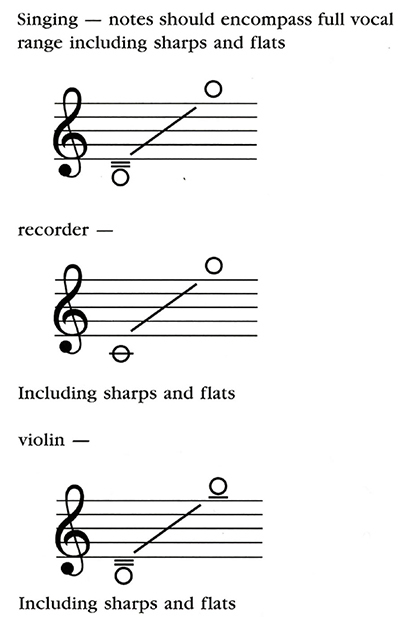
In addition to performing on instruments, students need to reinforce their learning by completing many written tasks which address issues of notation and general musical logic. These tasks should be compiled in workbooks which address notation in general and the various instruments specifically.
-
- (e) Note reading—students should be encouraged to learn to play familiar music which contains rhythmic concepts they have not yet learned by utilizing their knowledge of the spacial notation to play the notes and figuring out the rhythms by recalling them from memory. In this way students learn some advanced rhythmic concepts without need of formal instruction. Formal instruction which should eventually follow will merely codify concepts which the student has already formed.
- (f) Movement to music:
- (1) Traditional national dances—waltz, mazurka, czardas, etc.
- (2) Basic ballet
- (3) American folk dances—Virginia Reel, square dance, etc.
- (g) Integration of singing with instrumental playing and dance:
- (1) Liturgical
- (2) Traditional
- (3) Simple theater: not necessarily full-blown productions, but, rather, short scenes and enactments which utilize the present skills of the students
- 4. Grades 5 and 6
- (a) Singing—students at this point should be able to read the notation for practically any music they sing. Sense of pitch and rhythm should be highly developed. The literature used for singing should include:
- Psalms
- Hymns
- Liturgical music
- Choral music (sacred and secular)
- 2-part and 3-part rounds
- 2-part and 3-part harmony
- (b) Instrumental
- (1) keyboard—more advanced concepts to include:
- Scales
- Chords and arpeggios
- Basic tonal concepts
- Baroque pieces
- Sonatinas
- Transposition
- (2) Strings
- [(a)] Violin playing to include: shifting into 2nd and 3rd positions; scales and arpeggios in all major keys; music to include Baroque and Classical [(b)] Introduce viola, cello, bass
- (3) Winds and brass—introduce:
- Flute
- Clarinet
- Alto saxophone
- Trumpet
- Trombone
- (1) keyboard—more advanced concepts to include:
- (c) Ensemble
- (1) Duets for any combination of instruments
- (2) Instrumental trios and quartets
- (3) Instruments in conjunction with singing and/or dancing
- (d) Notation
- (1) Scales and chords in keys to 4 sharps and 4 flats
- (2) Workbook programs
- (3) Transposition
- (4) Making simple musical arrangements
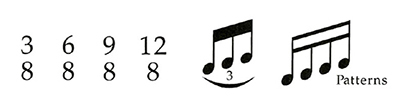
- (5) Rhythmic concepts to include:
- (e) Movement to music
- (1) Classical ballet instruction
- (2) Basic modern dance instruction including liturgical dance
- (3) Continued folk and national dance participation
- (f) Integration of music and movement in the form of:
- (1) Liturgical
- (2) Classical
- (3) Broadway type presentations (not full shows)
- (a) Singing—students at this point should be able to read the notation for practically any music they sing. Sense of pitch and rhythm should be highly developed. The literature used for singing should include:
By the end of 6th grade, students who have received musical instruction as outlined above are ready to use their skills in more highly developed ways. The curriculum for middle and high school should include:
- (1) More advanced choral participation
- (2) Band, orchestra, ensembles
- (3) Harmony, orchestration, composition, arranging
- (4) Advanced dance
- (5) Musical Theater
- (6) Liturgical music
- (7) A higher degree of integration of skills, as for example:
a. Keyboardists playing with choral and instrumental groups
b. Keyboardists leading the music for worship in classes and in church
c. Instrumentalists participating with singers and/or keyboardists in choral works and in instrumental ensembles
d. Peer teaching—advanced players coaching elementary players and supervising their instruction and practice—playing duets with them—accompanying them
e. Dance integrated with choral and/or instrumental music, performing sacred and secular works
The music curriculum, as outlined above, can be readily implemented in a small Christian school by 2 or 3 capable teachers. The emphasis in teaching should always be on learning music as literature (reading) and utilizing the fruits of study to: 1. give praise to God for all his glory; 2. enjoy the rich blessings of our great musical heritage; and 3. rejoice in the fellowship of musically literate friends and family with whom the praise and blessings may be shared.
In no way should musical skills be used to express personal pride, glorifying individual technical prowess, or to, God forbid, become a weapon used in contests and competitions where the most digitally correct and advanced players of instruments and the singers with the widest range and greatest pyrotechnics humble ignorant observers into awe-struck submission and envious admiration.
The gift of music is a blessing of the Holy Spirit, true and beautiful and available to all who with a humble and willing spirit will become its students, patiently developing those skills which lead to the rich reward which God has bestowed on us through his musicians. Then we can experience the joy of offering bits of this treasure trove back to our Creator, a joy that knows no bounds.

- Alan Jemison