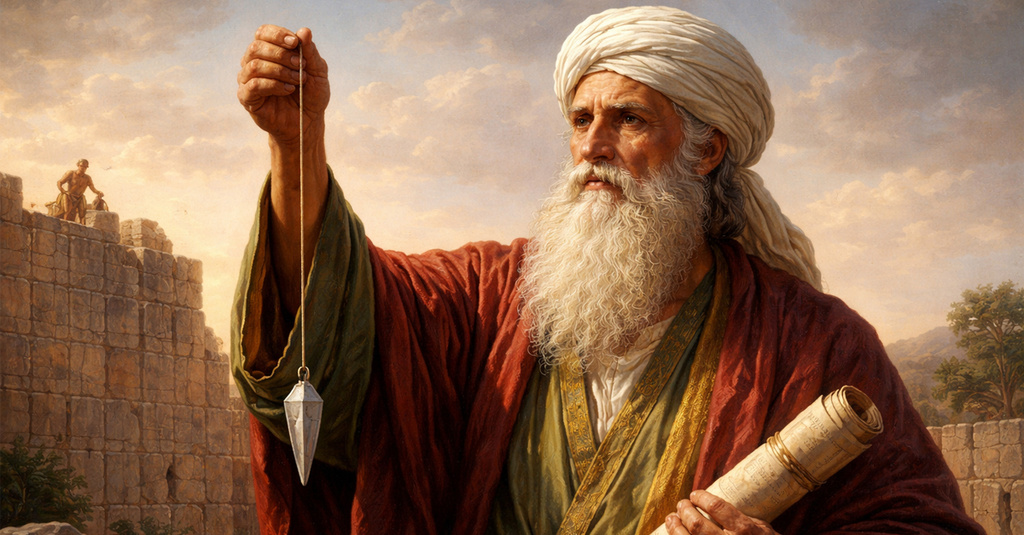
“The Book of Reconstruction”
An exploration of Zechariah’s God-centered vision of reconstruction, contrasting human expectations with divine action and calling believers to renewed confidence as they labor amid scorn and insufficient resources.

- Martin G. Selbrede
As we begin a new calendar year, it is fitting to understand the public nature of the hostility against Christian reconstruction and the proper response that hostility calls for. It is a time for girding our loins and renewing our focus on labor that God will prosper. That labor isn’t always ostentatious, given over to cheers from today’s jaded crowds. But there will be rejoicing in work done in faithfulness to His kingdom. And that work will invariably prove the naysayers wrong, time and again. But that won’t stop our detractors here and now. This requires us to reacquaint ourselves with the contours of this battle of the narratives, and there is no better text to guide our discussion than the fourth chapter of Zechariah, verses six through ten.
While Nehemiah has been rightly called “the book of reconstruction” (cf. Dr. Douglas F. Kelly’s sermon series for Chalcedon on that book), the prophecy of Zechariah provides a God’s-eye view of what Ezra and Nehemiah encountered. Exhortation is never more potent than when it comes from Zechariah’s hands, for God Himself is the true mover and shaker in history. Further, the conflict depicted is timeless enough to be particularly relevant to our time.
The passage in Zechariah contrasts man’s way with God’s way, the former futile and the latter invincible. Man, of course, reverses this picture entirely, putting his collective weight to work to enforce this reversal, by word and by deed. Man focuses on things he regards highly: might and power. But these are peashooters in contrast to God’s Spirit. Yet men insist that God, to be taken seriously, must rule the world through might and power, through coercive force, preferably using the state as His sock puppet. It is offensive to them to hear God set aside their preferred mechanisms when they read, “Not by might nor by power, but by My Spirit, saith the Lord of Hosts” (Zech. 4:6).
The obstacles that loom large in man’s eyes are as nothing to the God for Whom “the nations are as a drop in the bucket, and less than nothing” (Isa. 40:15-17). Men still treat God’s use of humble means with contempt, which is answered in Zech. 4:10.
As in our modern era, there was a massive project to be undertaken with inadequate means and resources and a multitude of enemies circling His people with increasing derision. It is fitting to begin the new year reminding ourselves of the strong medicine God has provided in the fourth chapter of Zechariah’s prophecy.
What’s Despised: Small Things and Tin Stones!
It is almost as if God goes out of His way to make sure His enemies have cause to gloat and mock. He does so because men are prone to boast if He were to act as they advise, but no one is His counselor. He chooses the weak to confound the strong, the foolish to confound the wise, and in all particulars wreaks havoc on humanistic expectations. God doesn’t ask us to give Him five-star reviews or to smash the Like button. These are all symptoms of man’s folly and his pathological trust in himself.
We’ll engage the text at Zech. 4:10, where God mocks the collective contempt for His work being raised up in the midst of the peoples.
For who hath despised the day of small things? He reproves their ungrateful unbelief, which they felt because of the humble beginning compared with the greatness of the undertaking; and encourages them with the assurance that their progress in the work, though small, was an earnest of great and final success, because Jehovah’s eye is upon Zerubbabel and the work, to support him with His favour.1
What does it mean to “despise” the day of small things? George Klein connects the dots for us:
The Hebrew word baz (NIV “despises”) means “to scorn, reject, or treat with contempt” (see Gen. 25:34 where Esau scorned his birthright).1
As concerning the “piece of tin” described as a plummet, we learn that the Hebrew word here in Zechariah 4:10 is completely unique in Scripture. Klein points out that the “expression [ha’eben habbedil] occurs nowhere else in the Old Testament.”3
So we have here “small things” or “small beginnings” and a stone of tin, tied to a string to serve as a plumb-line: the least expensive tool in a builder’s toolkit. These incite the despisers to open up against those who are engaged in the work.
Yet faithfulness in little things is extolled in Scripture, even if it is mocked by men. We must not listen to the message of the detractors, allowing them to derail God’s work under our hands.
Richard D. Phillips, in describing the encouraging character of seeing men being faithful in little things, brings Calvin into the discussion in an appropriate manner:
Seeing the plumb line in the hands of such a builder tells us that we shall at length see great things that are only dimly visible now. John Calvin writes, “For though the Lord begins with little things, and as it were in weakness, yet the plummet will at length be seen in the hand of the Architect for the purpose of completing the work.”4
But we have more than a vague hope in God moving things along, we have clear teaching that even immense obstacles to progress will be leveled.
The Inexhaustible Candlestick That Levels Mountains
Phillips notes that “Zerubbabel is to leave the leveling of the mountain to God, while he gets on with the work God has given him to do.”5 In other words, “it is God’s power that ensures success and motivates the effort, but God’s people have to do the work nonetheless.”6 As Phillips concludes earlier in his discussion, “God’s power for us spurs us on to action and not to inaction.”7 Christian reconstructionists understand their labors as being embedded in the historic growth of God’s kingdom, because they are future-oriented and Kingdom-centered.
Thomas V. Moore encapsulates the thrust of Zech. 4:6 well (where the significance of the preceding candlestick is explained by the angel), leading into his discussion of the next four verses:
Here, then, were these lamps burning continually, lamps that man’s hand did not make, and does not feed, and yet supplied from a source that is exhaustless, the living trees that stand beside the candlestick. Now, if the strength to do God’s work comes from God, the weakness of man is no obstacle, for when he is weak then is he strong. Zerubbabel may have but few visible resources, but the work was one that after all was to be completed by God, and not by man, and however feeble the Church might seem to be, there was more for her than against her. Hence, as the Jew gazed on this ceaseless flow of strength and grace, he could forget the feebleness of man in the unfailing supply of the power of God.8
Moore sees the opening question of Zech. 4:10 as a sharp criticism, and the basis for reproving those who despised the small things is based on the difference between man’s and God’s estimate of the value of the work.
Verse 10 rebukes them for despising the feebleness of the Church in external resources, and overlooking her true glory. That glory lay in the fact that God’s eye (the seven eyes) was upon her in love, and although those eyes see all that is in the earth, the most mighty and most magnificent, yet they see nothing that is mighty enough to destroy the Church, or magnificent enough to eclipse her true glory.9
When I lectured in Mexico a few years back, I illustrated this by detaching the mouse from my laptop. I held the mouse by the wire so that it behaved like a plumb-line, doing so in front of the conference attendees. It didn’t look like much as I walked across the stage checking for which objects were straight. Despite man’s low opinion of this cheap tool, I pointed out that God’s seven eyes were all focused on the plummet (the computer mouse), making it more important than anything else in the world. (This was clearly an off-label use of a computer mouse.)
Respecting Zech. 4:6, Leupold explains what “might” and “power” in the sentence mean:
They represent every human resource and ability such as physical or mental strength, all material and spiritual resources – even armies for that matter. They represent everything that man can muster. All this is brushed aside as being inadequate in administering the kingdom. A greater agency must be secured; in a greater power must all confidence be placed.10
The bringing forth of the capstone is accompanied by “shoutings crying Grace, Grace, unto it.” Leupold explains how intense these shoutings are.
Teshu’oth are “crashing bursts of applause.” By their very intensity these expressions of joy testify to the high degree of joy that will be attained: joy will wax vociferous.11
Maybe these initial efforts don’t appear to warrant praise and accolades, but God sees things differently.
Don’t Use Humanistic Eyes
Leupold further opens up the tenth verse by way of application, to which we should carefully attend as well.
There is danger that the weaker in the faith will be able for the present to discern only “small things” as the eye of man views matters. … This statement of the case is a warning not to fall into this error, for those who know God’s manner of working are aware of the fact; no outward display accompanies it. … “Do not despise the day of small things.” This is a plea not to run with the crowd and become guilty of its foolish judgments.
What reason is there for not being disturbed by these days of small things? Answer: the watchful care of God. For God’s seven eyes take joy in beholding even so trivial an action as Zerubbabel’s going about here and there, dropping the plummet to test whether the wall is being constructed true to the perpendicular. If such minor activities of men are observed by God and cause Him joy, what broad conclusions may men not draw as to the extent to which God’s zeal supports the work?12
Leupold points out the contrast between the geographic range of God’s seven eyes (as identified in Zech. 3:9 and repeated here at 4:10) and their preferred point of focus, despite that immense range.
The eyes of God are represented as being seven in number to indicate how far richer the divine forms of activity are than the human. If they can “run to and fro” (meshotetim, to scan at a rapid glance) they can discern all and select for particular attention the things of actual moment. [e.a.]13
Which is precisely the point: of all the things in the world which God’s eyes can observe, the most momentous thing was the inexpensive stone of tin, tied to a string, insuring that the reconstruction is proceeding straight and true, despite being a work prosecuted in the midst of hostility.
The Nature of the Opposing Mountain
We should not lose sight of the two questions raised in verse 7 and verse 10: “Who art thou, O great mountain?” and “Who has despised the day of small things?” The word Who here denotes the world of human volition (otherwise we’d have expected “What are you, O great mountain?). There is human opposition to be overcome, and human contempt of God’s humble means to be answered.
But if a more literal sense of “mountain” is demanded, it may well be the mountain of ruins to be transformed. Boda explains this possibility for us.
A “ruin hill” is a regular feature in ancient texts depicting the destruction of a city or structure, and the clearing and excavation of these hills was an essential stage in the project prior to foundation-laying. This clearing results in the former ruin hill (great mountain) becoming a level place. … in Zech. 4:7 this leveled place makes possible the foundation-laying.
Which is to say (on this interpretation) that the kingdom of God is built on the ruins of the kingdom of man. This idea is stressed in Isaiah 58:12, where foundations are raised up as the old waste places are transformed by God’s builders: the foundations of many generations, in fact.
But Boda points out a possible (and quite interesting) connection between the mountain and the priests who were in opposition to reconstruction of the Temple under Zerubbabel’s hand. He develops the idea that the leveling of the mountain (representing religious opposition to Zerubbabel’s work) proceeds from a moral action of God in judgment. “If the opposing mountain can be linked to opposing forces, it is possible that double entendre is also at play in the image of the level place which will be created by Zerubbabel’s dismantling of the mountain.”16 Boda concludes that “the opposition represented by the mountain is not merely the great task that lies ahead in the reconstruction of the temple, and not even merely the lack of support from priestly groups, but more importantly the ethical challenges created by a lack of justice.”17 Boda’s summary is worth sharing:
Not only would the mountain of ruins be transformed into a plain for a temple, the mountain of priestly injustice would be reduced to the plain of royal justice.18
Boda arrives at this conclusion by pointing out that justice is the focus of Zechariah 3 and Zechariah 5, so Zechariah 4 does not divert attention away from this emphasis. Paraphrased in modern language: the mountain of antinomianism and its fruit would be reduced to the plain of justice based on the Law.
Why a Plummet:
Commentators have noticed that Zerubbabel is not holding a trowel, but a plummet stone. Why not a trowel, an instrument used in the people’s reconstruction efforts? Simply put, you can build a very crooked building with a trowel. In fact, there are myriads of crooked, humanistic structures in existence today, and their problem was not a lack of workers with trowels. There was nobody holding a plumb line to show the morally straight and true way to build: in fact, anyone purporting to have God’s blueprints was maligned and rejected.19
A parallel idea is expressed in the well-known opening verse of Psalm 127: unless God is building the house, the builders are working in vain. How do you know God is building the house (morally understood)? It is built to be morally straight, using the plumbline of God’s law to insure that from foundation to capstone, it embodies God’s justice as revealed in Scripture. See my discussion in The Smiths of Zechariah where we explored this idea of Zech. 1:18-21 in detail.20
Why not fix what’s broken rather than start from scratch? You can see that question mirrored in the contrast between most versions of Christian Nationalism and Christian Reconstruction. The answer lies in Isaiah 58:12 and parallels: we don’t rebuild the waste places directly, we raise up foundations in the middle of the waste places – a new work. We can’t build God’s kingdom from the dross of man’s kingdom. The dross ends up on the slag heap of history, just as the chaff is driven away by the wind and no place will be found for it. More succinctly, “Every plant, which My heavenly Father hath not planted, shall be rooted up” (Matt. 15:13). This is why we homeschool or build Christian schools, even generalizing this impulse to include parallel economies based on just weights and measures, etc. In all this, God’s plummet is central.
When postmillennialists are criticized (wrongly) for “polishing brass on a sinking ship,” the actual truth is more damning. Humanists are the ones polishing brass on a sinking ship: the entire humanistic enterprise will sink. God will shake everything until only the unshakeable things will remain, and that ongoing disintegration includes the countless edifices to humanism and its false gods and its pretended autonomy.
Yet, humanists continue to build humanistic institutions to embody humanistic power. They have the trowels. They don’t have God’s plummet. The dominion impulse in man is directed toward the glorification of man, but it is still very much there, starting as early as Cain’s building a city for himself and his posterity. The motives haven’t changed since then.
Reconstruction: By Man’s Hand and God’s Power
Human agency is an important element in the second half of Zechariah 4. Boda bids us to pay attention to the repetition of this element in respect to the hand or hands in the passage:
The hands of Zerubbabel have laid the foundation of this house; his hands shall also finish it; and thou shalt know that the LORD of hosts hath sent me unto you. … For who hath despised the day of small things? For they shall rejoice, and shall see the plummet in the hand of Zerubbabel … (Zech. 4:9-10).
Some things are done without human hand (Job 34:20b), but reconstruction proceeds by the faithful work of our hands – while it is God Who gives the increase.
Once the reconstruction project is initiated, big changes are in the wind. Boda describes here the contrast between Haggai’s perspective and that of Zechariah’s, with an eye to the ultimate results arising from such modest means.
While Haggai focused on the insignificance of the temple project (possibly the size of its footprint or the magnitude of its destruction) at an earlier stage in the project, Zechariah focuses on the insignificance of the act of foundation-laying. The prophet is admitting that not much seems to have been accomplished, but in the ancient Near East this day was monumental indeed, something reflected in Haggai’s earlier speech in Hagg. 2:10-23. Such a day would signal a shift from curse to blessing, and even set in motion cosmic shifts that would overturn empires.21
The talking points used by the opposition adopt two distinct but mutually-supporting tactics.
On the one side, the significance of the challenge of the project is maximized by calling the mountain great, while on the other, the significance of the progress on the project is minimized, by calling the day insignificant.22
Despising the Reconstruction Process
When Boda comes around to expounding the sense of “despising,” of the contempt embodied in the Hebrew word baz, he doesn’t restrict the scope of its impact.
These various contexts suggest a strong repulsion for the activity of the other. For Zechariah, this was very serious and threatened to undermine the rebuilding project.23
We can translate it this way: those who despise the day of small things have a strong repulsion for the activity of those engaged in reconstruction. I am, of course, using the word reconstruction in two different ways: the building of the literal second temple after the Babylonian exile, and Christian reconstruction as a New Testament form of building God’s kingdom in the midst of His enemies. Both of these activities are referenced in Zechariah –the physical edifice in chapter 4, the Temple made without hands in Zechariah 6:12-13.
Boda surveys all possible meanings of the tin stone upon which God’s eyes are focused, but his concluding comment inserts an element not mentioned by other expositors.
While the tin stone may be a measuring instrument representative of the building activity which Zerubbabel will supervise after the foundation-laying ceremony, it may also allude to Zerubbabel’s role in establishing justice. [e.a.]24
It is not merely the temple structure that is to be built physically straight, but the work involves making everything morally straight. We’ve emphasized this point in previous articles in Arise and Build involving Christ’s work in making crooked things straight25 and not limiting the scope of the healing Christ has undertaken.26
The connection of Zech. 4:10’s seven eyes “which run to and fro through the whole earth” with 2 Chron. 16:9 must not be dismissed, since “the eyes of the Lord run to and fro throughout the whole earth” appears in both passages. The proper sense in the Chronicles passage is that His eyes “strengthen those whose heart is completely directed towards Him,” and this strengthening “usually refers to an increase in inner courage.”27 The increase of inner courage is promised for “those whose heart is completely directed towards Him.” Devotion to God brings forth the inner courage to proceed with reconstruction despite hostile adversaries.
Inner courage motivated Zerubbabel to leave his earlier life and begin the task of reconstruction.
He readily quitted a position of honour and influence in the land of his sojourn, to head the return of a comparatively feeble remnant of his countrymen, and undertake the manifestly difficult, and probably hazardous task of laying anew the foundations of a Hebrew commonwealth. There were just 42,360 men who returned with him to the ruins of Jerusalem and the smallness of their number was aggravated by the general desolation and the external difficulties they had to contend with.28
R. J. Rushdoony on Zechariah 4
Dr. Rushdoony points out that Fairbairn isn’t saying that Zerubbabel had 42,360 committed godly men to work with. Rather, many of them “were opportunists and time servers and hypocrites.”29 So Fairbairn’s numbers, as anemic as they are, are actually worse than suggested. Rushdoony continues thus:
It seemed, indeed, as though nothing could be more insignificant than the work of Zerubbabel and Joshua as they stood surrounded by a world of evil and had evil in their own midst. The discouragement was very great.30
Such discouragement arises from an anthropocentric view, a man-centered perspective, which falsifies the situation. As Rushdoony notes, “if the strength to do God’s work comes from God, the weakness and frailty of man cannot be an obstacle.”31
Circumstances, if they are going to dictate to us, require that we surrender our hope in God. If we are going to move by God, then we must not be disheartened by circumstances.32
To most readers’ surprise, Rushdoony titled his chapter on Zechariah 4 “Sources of Morality.” He explains this choice in mid-chapter. “It is important to recognize that historically there have been two sources of morality,” he says.33 Put simply, we derive our morality from either God, or from the group. Our views of good and bad, right and wrong, are either part and parcel of group morality or of God’s law. And in Zechariah 4 there is a showdown between those who clung to the group’s collective opinion and those who clung to God. Rushdoony connects this with the perennial choice between walking by sight and walking by faith. Walking by sight means accepting the group consensus. Walking by faith means not staggering at the promise of God regardless of circumstances.
If you are going to move in terms of sight, you will despise the day of small things, of small beginnings, and you will say wherever God’s work is begun, wherever a foundation is established in terms of God’s purposes, “This is futile. This is nothing as against the monstrousness of the evil.” This is to despise the day of small things.
God or circumstances? Will we allow circumstances to be our god or will the Lord reign over us? Will we walk by faith or by sight? What will be the source of our morality: God or the group?34
Rushdoony’s denunciation of this collective approach to morality elicits a personal recollection.
They look around them and their whole principle is one of: What is the group doing? And how big a group can we get for our cause? Someone recently who claimed to be a Christian and a conservative was belligerently insistent that nothing could be done for the conservative cause or for the Christian cause unless you lined up millions. In other words, all power is in the group and none in God.35
And how is Christian reconstruction viewed today? Nobody analyzes it from a Biblical perspective, but only from a group perspective, with the focus on might and power (in direct opposition to Zech. 4:6). Christian reconstruction is treated contemptuously, especially since it advocates for faithfulness in the day of small things. It takes an immovable faith to handle the withering assaults of the despisers of our era in the church and without.
Men Who Tear Up Mountains
What do we make of those men who level mountains in our era, who labor to challenge whatever exalts itself against the knowledge of God? In that circle we would include men like Cornelius Van Til, Greg Bahnsen, and R. J. Rushdoony. Wright gives us a glimpse into Hebraic thinking on this point in his comments on Zechariah 4:7:
Lightfoot has observed that a similar expression was used in the schools of the Jews, in which men distinguished for their deep learning and splendid virtues were spoke of as “tearers-up” or “removers of mountains.”36
These certainly are fitting titles for men like Van Til, Rushdoony, and Bahnsen: the reconstruction project certainly needs men who are “tearers-up of mountains.” Such men change the tilt of the playing field between the kingdom of God and the kingdom of men, enabling us, their spiritual heirs, to build His kingdom straight and true. Only men who refuse to despise the day of small things can be fully used of God. Wright notes that C. F. Keil held that “no one who seeks to perform or accomplish anything great ever does despise the day of small things.”37
Therefore, rejoice in the day of small things, the day of faithfulness, the day we use God’s plummet-stone, rejecting group consensus for the more sure word of prophecy. You’ll then be prepared to resume building with renewed zeal and implacable commitment based on the inexhaustible resources of the Lord Jesus Christ.
1. A. R. Fausset, in Jamieson, Fausset and Brown, A Commentary on the Old and New Testaments (Grand Rapids, MI: Eerdmans, 1982 reprint), vol. 2, part 2, p. 672.
2. George L. Klein, The New American Commentary, Vol. 21B: Zechariah (Nashville, TN: B & H Publishing Group, 2008), p. 162, citing from HALOT (acronym for The Hebrew and Aramaic Lexicon of the Old Testament edited by Koehler and Baumgartner), pp. 114-115.
3. Ibid.
4. Richard D. Phillips, Zechariah (Phillipsburg, NJ: Presbyterian & Reformed Publishing, 2007), p. 107.
5. Ibid, p. 102.
6. Ibid, p. 103.
7. Ibid.
8. Thomas V. Moore, A Commentary on Haggai, Zechariah, and Malachi (Edinburgh: The Banner of Truth Trust, 1979 [1856]), p. 159.
9. Ibid, p. 160.
10. H. C. Leupold, Exposition of Zechariah (Grand Rapids, MI: Baker Book House, 1971), p. 87.
11. Ibid, p. 90.
12. Ibid, p. 91-92.
13. Ibid, p. 92.
14. Mark J. Boda draws attention to this. Cf. Mark J. Boda, The Book of Zechariah (Grand Rapids, MI: Eerdmans, 2016), p. 295. This volume is part of The New International Commentary on the Old Testament.
15. Boda, op. cit., p. 296.
16. Ibid, p. 298.
17. Ibid, p. 298.
18. Ibid.
19. See David Chilton’s fascinating take on this in his parable of the missing blueprints. You can read it online starting on page 168 at this link: https://chalcedon.edu/resources/books/jcr-vol-08-no-1-symposium-on-social-action
20. https://chalcedon.edu/resources/articles/the-smiths-of-zechariah
21. Boda, p. 302.
22. Boda, pp. 302-303.
23. Boda, p. 303.
24. Boda, p. 304.
25. https://chalcedon.edu/resources/articles/the-crooked-shall-be-made-straight-2
26. https://chalcedon.edu/resources/articles/the-scope-of-healing
27. Boda, p. 307.
28. Patrick Fairbairn, ed., Fairbairn’s Imperial Standard Bible Encyclopedia (Grand Rapids, MI: Zondervan, 1957 [1891]), vol. 6, p. 146.
29. Rousas John Rushdoony, Sermons in Zephaniah, Haggai & Zechariah (Vallecito, CA: Chalcedon/Ross House Books, 2023), p 82.
30. Ibid.
31. Ibid, p. 83.
32. Ibid.
33. Ibid, p. 85.
34. Ibid, pp. 84-85.
35. Ibid, p. 86.
36. Charles H. H. Wright, Zechariah and His Prophecies (London: Hodder and Stoughton, 1878, modern reprint through HanseBooks.com), p. 96 n.2
37. Ibid, p. 98.
- Martin G. Selbrede
Martin is the senior researcher for Chalcedon’s ongoing work of Christian scholarship, along with being the senior editor for Chalcedon’s publications, Arise & Build and The Chalcedon Report. He is considered a foremost expert in the thinking of R.J. Rushdoony. A sought-after speaker, Martin travels extensively and lectures on behalf of Christian Reconstruction and the Chalcedon Foundation. He is also an accomplished musician and composer.