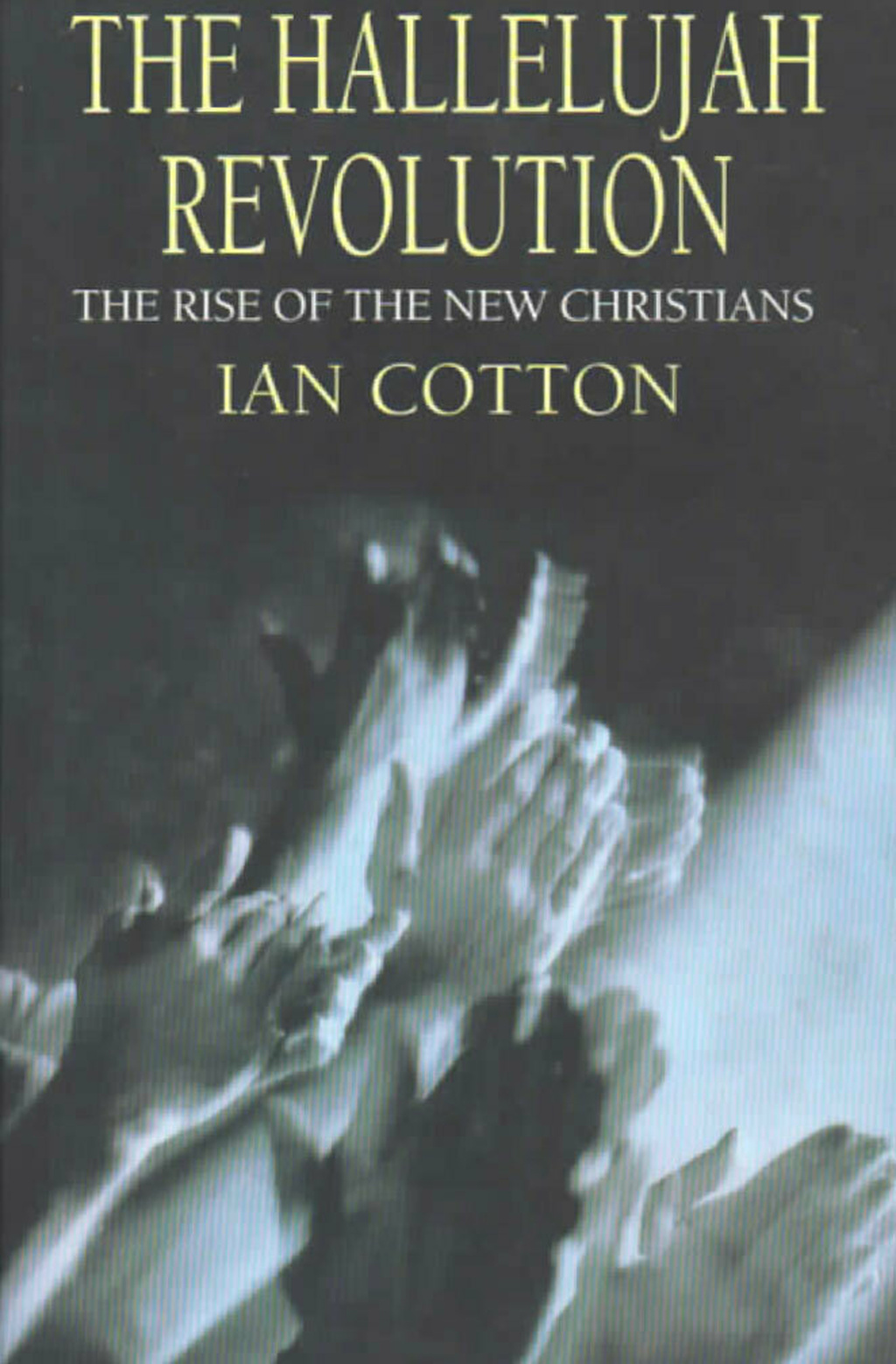
The Evangelical/Charismatic Betrayal—A Review of The Hallelujah Revolution: The Rise of the New Christians, by Ian Cotton
Something strange and terrible is happening to evangelicalism. Even as early as mid-century it had its right-wing critics, notably the "militant” fundamentalists, some of whose acrimonious prescience miffed their more refined neo-evangelical stepbrothers who poo-pooed the critiques. Today titles mirroring Francis Schaeffer’s The Great Evangelical Disaster like The Scandal of the Evangelical Mind verify the insight of the mid-century fundamentalists. Almost everybody acknowledges evangelicalism confronts a serious crisis, not only of identity, but also of existence: what is today called evangelicalism looks suspiciously like liberalism of the days of yore (see especially John MacArthur’s Ashamed of the Gospel).
- P. Andrew Sandlin
Something strange and terrible is happening to evangelicalism. Even as early as mid-century it had its right-wing critics, notably the "militant” fundamentalists, some of whose acrimonious prescience miffed their more refined neo-evangelical stepbrothers who poo-pooed the critiques. Today titles mirroring Francis Schaeffer’s The Great Evangelical Disaster like The Scandal of the Evangelical Mind verify the insight of the mid-century fundamentalists. Almost everybody acknowledges evangelicalism confronts a serious crisis, not only of identity, but also of existence: what is today called evangelicalism looks suspiciously like liberalism of the days of yore (see especially John MacArthur’s Ashamed of the Gospel).
Not the least problem, and perhaps the most serious, is the "charismaticization” of evangelicalism; the structure and effects of the union of the two movements is the theme of Cotton’s truly disturbing work (published by Prometheus Books, 59 John Glenn Drive, Amherst, New York 14228-2197).
Almost everybody knows the Charismatic Movement is being split by the excesses of the so-called "laughing revival” on the one hand and, on the other, the increasing recognition of the necessity of the recovery of orthodoxy and objective theology by many of Charismaticism’s former supporters. Not a few of the latter have embraced the Reformed faith and Christian Reconstruction. What has driven many of this latter category is precisely the sort of deviations and shenanigans Cotton discusses in this book.
This book, however, is not about those Charismatics that have become (or are becoming) orthodox Calvinist reconstructionists. All to the contrary, it is about the intensely Arminian, almost Pelagian, certainly latitudinarian, wing of the Charismatics. The New Christians, as Cotton calls them, are quite out of tune with Calvinism. They are quite out of tune with almost anything valid in the church for the last 2000 years, for that matter. Cotton discloses and documents the advent of the burgeoning new Evangelical/ Charismatic axis.
Cotton’s description of the new Christians is disturbing: religiously evangelical, instinctively irrational, politically moderate or liberal (usually supporters of Bill Clinton), economically socialistic (though anti-statist), theologically feminine (preferring a "gentle, feminine Jesus over a macho, stern Jehovah”), vocationally "postindustrial,” experientially "relational,” and socially egalitarian ("mutual accountability”).
The new Christians support "crossing boundaries,” cross-denominationalism, theological eclecticism, interdisciplinary vocationalism. The concept of objective and transcultural truth to which the church has held tenaciously for two millennia withers under the New Christians’ utilitarian modernity. The boundary crossing springs from an almost conscious dialectical orientation (pp. 24, 25):
Hold on to your”/”; you’ll need it. Because on the one hand,—the left side, as it were, of the "/”—Evangelical Christianity—does indeed contain the most adamantine rigidities. On abortion they are unequivocally, wholeheartedly "pro-life.” Sex is unthinkable—un-Biblical! before marriage. Sin is original, inevitable, and ingrained, Satan, otherwise "the Enemy,” is alive and plotting—he black, we white. The Apocalypse? Revelation was right.
On the Charismatic side of the equation, it’s another country. Instead of grid-like rigidity we have the go-with-the-flow attitude which de Bono characterized as "water logic.” Instead of reason and order, we have instinct, vision, the Holy Ghost. Instead of step-by-step linear progression, we have the all-at-once, the miraculous. Instead of the verbal architecture of the sermon, we have the preverbal instinctiveness of "tongues.” This is the distinctively modern end of the movement, where change, fluidity, uncertainty, and flexible boundaries are paramount. The Chinese use the concept of Tao to embrace such principles—the very word Fritjof Capra alighted on as he struggled to describe the "oriental” quality of late twentieth-century atomic theory in his book The Tao of Physics, [bold emphasis supplied]
The profound worldliness of the movement, the extent to which it mirrors the antirational, "holistic,” democratic, feminized modern culture, crops up again and again in the book (p. 70): "Once again, as gentle (hip) Jesus moves foreground and adamantine (square) Jehovah steps back, you get a sense of the overlap between New Christianity and New Age—a sense you often get when looking at the relationships (as opposed to doctrine) of this most relationship-based New Christian movement [March for Jesus founder Tom Pelton pontificates "Christianity. . . is relationship rather than property based” (p. 228)].”The New Christianity seems the Christian version of the modern ethos.
Cotton notes several times the distinctly feminine outlook of the New Christians. Of the use of "cross-fertilization” business practices sharply influenced by today’s management techniques, he notes (p. 78):
All of which is impeccable modern management, with the particular flavor of what has been called the "feminization” of business. Academics such as those Harvard Business School feminists Shoshana Zuboff (In the Age of the Smart Machine) and Rosabeth Moss Kantor (When Giants Learn to Dance) would love all this (once they have got over the fact these folks are "fundamentalists,” that is).
In the business environment what the New Christians advocate is the " ‘sense of community’,” "the symbolism of equal pay [for all],” and "everyone parent[ing] everyone else.” Business here is as much about self-worth as net worth. This feminized business approach is simply one feature of a wider feminized paradigm. It is mirrored in evangelical conclaves supporting "men’s encounter groups” and "mentoring.” Thus, Promise #2 of Promise Keepers, an archetype of the New Christians, is, "A Promise Keeper is committed to pursuing vital relationships with a few other men, understanding that he needs brothers to help him keep his promises” (Stu Weber, "Someone to Lean on,” Focus on the Family, June, 1996, 3). The bent to shift responsibility for covenant obligation (and what is Promise keepers but a pale, feminized shadow of virile, Calvinistic covenantalism?) is particularly telling, and its effect is to dilute the bonds of covenantalism. The extent to which Promise Keepers mirrors and indulges the New Christians is exhibited in recent statements from two of its speakers:
When a question was asked at a press conference regarding ‘ "laughing revivals”—where those involved "bark like dogs” and "bray like donkeys”—Dr. Henry Blackaby (SBC) said, "We don’t try to evaluate that, and neither do we take a position regarding women serving as pastors.” Dr. Joseph Stowell immediately declared, "Our God does not ever wear an angry face. He deals with compassion,” Ralph C. Colas, "1996 Clergy Conference for Men—Theme: ‘Fan the Flame,’” The ACCC Challenge, Vol. 2, No. 2 [April, 1996]
Cotton’s specific treatment of the ubiquitous March for Jesus, the prominent English avant garde tribe Ichthus and business group Pecan, and "revival ministries” of itinerants like Morris Cerullo finds a striking (frightening) American parallel in Promise Keepers.
Nestled prominently amid Cotton’s revelations of the Evangelical/Charismatic axis are deeply naturalistic and materialistic explanations of religious experience (drugs, stress, brain chemicals) by which Cotton rationalizes the Charisma side of the equation. Cotton stops short of asserting that these explanations undermine religion or faith (in the modern mystical, antirational climate, that would be unforgivable). Indeed, Cotton’s treatment of Canadian neuroscientist Dr. Michael Persinger’s experiments with TLT (temporal lobe transients) as inducers of mystical experience are most fascinating. The author attributes much of the abounding hucksters ("healings”) among the New Christians to psychosomatic causes: the body is endowed with remarkable self-healing powers, released at emotionally charged meetings like those of the New Christians. An intriguing chapter, "The Left and Right of It,” discusses the implications of the brain "hemispheric” theory for the Charisma: Cotton adduces evidence culled from the last thirty years of research that the right side of the brain is irrational, holistic, intuitive, spatial, color-and time-perceptive, etc. while the left is rational, fragmentary, logical, and one-dimensional. Cotton contends that the modern trend toward the mystical and antirational is the effect of the almost collective exercise of the right, rather than the left, side of the brain: i.e., everybody’s just using less of the left and more of the right ("[l]t is hard not to wonder whether some evolution in our most basic thought forms is also taking place” [p. 165]). These chapters, frankly drenched in speculative and evolutionary faith, do not mar the effectiveness of the descriptive parts of the book.
In the New Christians we perceive a final episode in the prostitution of the Faith, now forced to do homage to the man-centered, non-cognitive, anti-creedal, dialectical, feminized spirit of the age.
What is so vital to recognize is that in this new Evangelical/Charismatic axis we confront not a deviant theology, a heresy in the church, an aberrant lifeform, but a new species altogether. In Christianity and Liberalism J. Gresham Machen demonstrated that the latter is no subspecies of the former, that liberalism is in fact another religion altogether.
After reading Cotton’s book, I am convinced we can say no other of the New Christians.

- P. Andrew Sandlin
P. Andrew Sandlin is a Christian minister, theologian, and author. He is the founder and president of the Center for Cultural Leadership in Coulterville, California. He was formerly president of the National Reform Association and executive vice president of the Chalcedon Foundation. He is a minister in the Fellowship of Mere Christianity.. He was formerly a pastor at Church of the Word in Painesville, Ohio (1984-1995) and Cornerstone Bible Church in Scotts Valley, California (2004-2014).