
Urban Nations Update: Let’s Talk About Jesus—In Spanish
By the grace of God, Urban Nations has now launched a ministry among the Spanish-speaking community of New York City. Phase One is teaching Bible-based English as a Second Language. Phase Two will be a correspondence course in the Reformed faith, operated in cooperation with a Dutch ministry.
- Steve M. Schlissel
By the grace of God, Urban Nations has now launched a ministry among the Spanish-speaking community of New York City. Phase One is teaching Bible-based English as a Second Language. Phase Two will be a correspondence course in the Reformed faith, operated in cooperation with a Dutch ministry.
The correspondence course is being administered by Duke and Elizabeth Zayas, Puerto Ricans with a fire for the Faith (more about them in a future issue, D.V). The ESL instruction is being provided by an extraordinarily gifted young woman, Josephine Tyne, who happens to be married to UN board member, James Tyne.
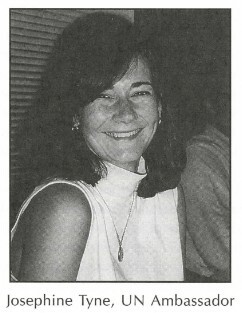
Josephine and Jim met when they were both working as federal attorneys in Manhattan. Last year God granted them a baby so beautiful, the members of Messiah’s Congregation want to petition Webster to put Patience’s picture next to the word, "baby” in the dictionary.
Josephine’s grandparents are from Spain, where many of her relatives still live. After the birth of Patience, Josephine found herself as a mother at home desirous of serving the Lord in a volunteer capacity with Urban Nations. UN would not only provide her with the opportunity to do hands-on mission work, but it likely could make use of Josephine’s excellent skills in the Spanish language.
Jim encouraged Jo to pursue a way thus to serve. We conferred and decided that a class composed of women only would permit Jo to bring Patience with her. So now, twice each week, Josephine travels from Jersey to Brooklyn and sets up shop in the UN office, teaching English and the Word of God to Latin-American immigrants. Each class member adores the baby (we’re not surprised), and the arrangement has been simply grand.
Below is a report I received from Jo on progress in the class. We submit it to the readers of Chalcedon especially Because of the insight it provides into the "organic-mechanics” of Urban Nations’ classes. Substantial Christian instruction occurs "naturally,” and in a context of genuine Christian love and concern. We trust you will join us in praising God for what He is accomplishing through His servants.—And now a word from Josephine Tyne:
When the tumult after registration settled down, three students remained in my Level One English Class: Leda, Rosa and Ninfa. All three are middle-aged Latin-American housekeepers who are seeking to better their situation in America by learning English.
Leda is the only student who received formal education through high school. She is intelligent, spirited, and (apparently) most receptive to the Christian gospel. By her own account she is a devout "Christian.” However, she is a member of the "Unity Church.” She describes it as a church taking a "metaphysical” approach to teaching about God. In fact, it is a cult.
Rosa, though less educated than Leda, is every bit as capable in English and even more determined to learn the language. After having worked for many years as a nurse’s aid in Mexico, Rosa aspires to enroll in nursing school here. She is reserved and introspective, and until recently has not shown much interest in the Christian Faith.
Finally, there’s Ninfa—rebellious, distracting, attention-grabbing and seemingly uninterested in learning English. Rather than participate, Ninfa generally prefers to "just listen”—or gripe. I began to wonder why Ninfa bothered to travel all the way from the Bronx to learn English in Sheepshead Bay, Brooklyn, when she is inattentive to the English instruction and even less interested in talking about Christ. She preferred, instead, to turn the topic of conversation back to herself.
The course began on an uneven note. Ninfa would consistently interrupt the class with banal comments, while the other students grew indignant. By the third class, it became clear that Ninfa was self-conscious about her lack of formal education and needed tutoring in grammar. So, I introduced the third class with a grammar lesson, which provided Ninfa with the self-confidence she needed to participate meaningfully. This was the beginning of a very fruitful session.
We turned to our Scripture reading, Mark 5:35-36. I asked What do these verses show about Jesus? All of the students agreed that the verses depicted Jesus’ power. What do these verses show about Jairus?, I continued. "They show his great faith,” my best student responded. My following question. What is faith and Why is it important?, led us to a most profitable discussion of the Gospel. I was able to explain—in their own language—that only by faith in Jesus Christ may we be saved from God’s wrath against us for our sin.
Sin, I explained, is not only stealing, murdering, and committing adultery, as one student believed, but it is our nature—the natural man’s thoughts are always evil all the time and unacceptable to a holy God. "And,” I added, "we cannot undo our own sin, no matter how many charitable or ‘good’ deeds we perform for our neighbors, and no matter how many times one goes to confession.”
"Oh?” they exclaimed with their eyes. "Yes,” I continued, "The Bible teaches that only Christ can mediate between us depraved creatures and the most holy and divine God.” I elaborated on these statements and explained that to believe otherwise depreciates God.
"Why do Protestants call themselves Protestant? What are they protesting?” Ninfa asked.
Thankful for the additional opportunity to talk about the sufficiency of the Bible as the final authority, I briefly summarized the history of the Reformation, and compared the unreliability of man and his traditions with the inerrancy of the Bible. The students listened intently, especially when I asked them How do you know right from wrong? What do you rely on? What is your final authority? If it’s your feelings, then what makes your sinful preferences objectively superior to anyone else’s? The students nodded.
Before long, we had surveyed portions of the Old Testament and compared God’s covenant administration under Moses with the New Covenant in Christ, as described in Hebrews.
At some point, we returned to the lesson and managed to complete most of the exercises before the class ended. By the next class, one of the students asked for directions to get to Messiah’s for the next Lord’s Day. I pray that she comes, even as I meditate on last week’s verse which we memorized in our book—"With God, nothing is impossible.”

- Steve M. Schlissel
Steve Schlissel (1952-2025) served as pastor of Messiah's Congregation in Brooklyn, New York, since 1979. Born and raised in New York City, Schlissel became a Christian by reading the Bible. He and Jeanne homeschooled their five children and also helped raise several foster children (mostly Vietnamese). In 2003, they adopted Anna (who was born in Hong Kong in 1988, but is now a U.S. citizen). They have eight foster grandchildren and fourteen "natural" grandchildren.