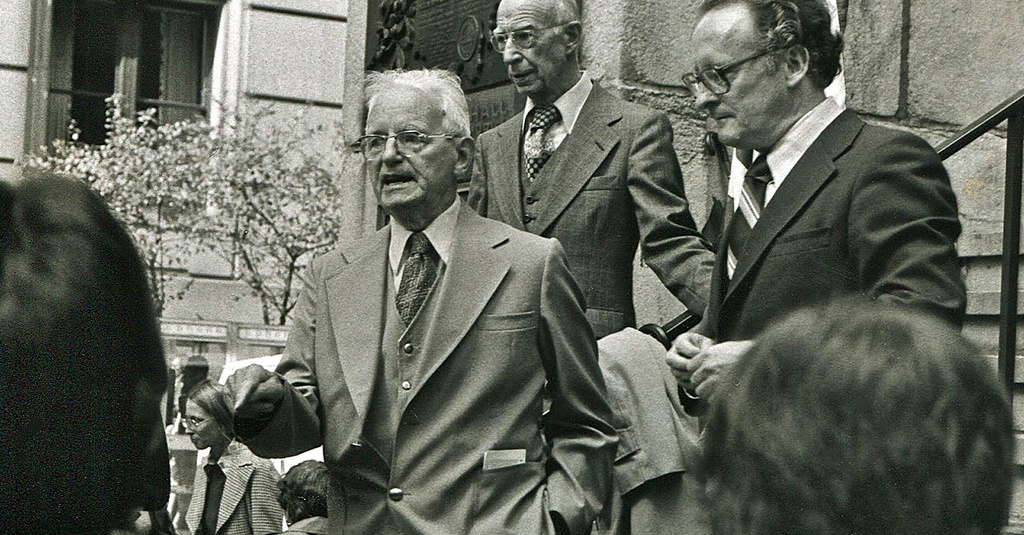
Van Til and Postmodernism
Presently in secular America there is a paradigm shift taking place which is originating in intellectual circles, but is quickly capturing the mind of the average American. It is a shift from what has been historically called “modernism” to that which is presently called “post-modernism.” It is a dramatic change in the way people think, and it is the outworking of what Dr. Cornelius Van Til of Westminster Seminary described years ago as “man becoming epistomologically self-conscious.” Simply put, man is biased in the way he knows things, and he needs to know that!
- Larry E. Ball
The Great Paradigm Shift
Presently in secular America there is a paradigm shift taking place which is originating in intellectual circles, but is quickly capturing the mind of the average American. It is a shift from what has been historically called “modernism” to that which is presently called “post-modernism.” It is a dramatic change in the way people think, and it is the outworking of what Dr. Cornelius Van Til of Westminster Seminary described years ago as “man becoming epistomologically self-conscious.” Simply put, man is biased in the way he knows things, and he needs to know that!
As Christians we should look upon this paradigm shift as an opportunity for evangelism. However, it is important to note, that only a presuppositional apologetic will be able to deal with this new way of thinking. Evidentialism as an apologetic method will be useless.
In this article I will attempt to explain the meaning of what I have just said. What is modernism? What is postmodernism? What is a paradigm shift? What is presuppositional apologetics and why is it the only weapon that can be adequately used as a tool to expose the fallacies of post-modernism, so that Christ may be properly presented to those caught in its trap? I will attempt to answer these questions to some degree in the following comments.
Most of us who were raised in the public schools and sent off to state colleges and universities in the sixties were taught under a world and life view called modernism. Even though many of us attended church on Sundays, in the public schools and colleges we were adopting a way of thinking often times very much antithetical to what we were learning in church. We were schizophrenic, and didn’t know it.
A Personal Testimony
So it was with me, having been raised in a conservative Presbyterian church, yet studying mathematics and physics on the college level at a state engineering school. in church I learned about God and h ow important he was. in the classroom I learned that God was irrelevant. In church I learned that God created the world. in the classroom I was taught that the world as we know it is a closed system governed by natural laws which are neutral in regard to questions about God. In church I learned that God spoke through the Bible. In the classroom I learned that through our minds, without reference to God, we can come to agreement via the scientific method about facts as we discover natural laws. In the church I learned that the ten commandments defined right and wrong. In the classroom I learned that even in the area of ethics there were natural laws defining right and wrong, and all men who will only properly reason with their minds will come to the same conclusions about what is right and wrong. Any reference to God was unnecessary. This was modernism and this was me in the sixties!
Toward the end of my college career I began to lose faith in modernism and also I began to doubt the validity of Christianity. I had thought that the study of mathematics would answer the ultimate questions of life. The more I advanced in the study of mathematics, the more I began to see that mathematics was built upon unproved axioms which had to be accepted by faith. At its root, mathematics was just another faith system. This greatly discouraged me. As I sought counsel from Presbyterian ministers, I was unable to find one who could give me Biblical answers to the tension I had developed between religion and science. Since the leaders of the church seemed to be mimicking the answers that I was hearing in the classroom (baptized, of course, with some religious language), I became very suspicious of the church. One pastor gave me a book entitled, I Believe In God And I Believe In Evolution. I was so disappointed that I never even read the book. Finally, by God’s providence I enrolled at Westminster Theological Seminary in Philadelphia where Dr. Cornelius Van Til was Professor of Apologetics.
Westminster Seminary was in its zenith in the sixties. John Murray, Jay Adams, Cornelius Van Til, E.J. Young, and other men of great caliber were all gathered at the same place to teach the Christian Faith. What a blessing for a young searching Christian like me! To say the least, I was overwhelmed. (As a little sidetrack to my article, I remember the first lecture, as a first-year student, I heard from Professor John Murray. I was asked afterwards what I thought of it. My response was, “I didn’t understand a word he said.” I was a slow learner and by the time I graduated three years later, I finally began to understand what Professor Murray was saying.)
The greatest blessing to me was the teaching of Dr. Cornelius Van Til. I was driven to Westminster partially because I was seeking a way to combine my dwindling faith in Christianity which I had learned in church and my dwindling faith in the scientific method which I had learned in college. Dr. Van Til clearly laid out the answers from what I consider the only Biblical apologetic faithful to the Scriptures, which has come to be called presuppositionalism.
Presuppositionalism
The presuppositional method asserts that the beginning point of all knowledge is the fact that God exists. There is no neutrality in the world, and all systems are at root religious, even the scientific method. The scientific method, if pushed to be consistent, is based upon faith in the belief that the world came into existence by pure chance, and in reality it has no basis on which to boast of any trustworthy laws or truth. The only reason it has had any success is because it has borrowed capital from the Christian Faith, namely, the assumption that order does and ought to exist in the world. Dr. Van Til used to say that in principle all predication is impossible except upon the presupposition of the full Christian position. The Christian Faith gives a basis for laws and truth because a self-contained God created the world and therefore gave it meaning. All systems are based upon certain presuppositions which men assume. in other words, all men are biased in their search for truth.
All men know that God exists, but unbelievers suppress that truth in rebellion. There are no neutral, brute facts. All facts are “God-created facts.” Any denial of this is rebellion against the true and living God. We must not let the world claim an area of neutrality where Christians and unbelievers seek together to investigate and reach some conclusion about the existence of God. To allow this area of neutrality, is to deny at the very outset the claims of God and to give the unbeliever stolen ground which he does not deserve.
Proclamation of the gospel, and not an intellectual argumentation depending upon the acceptance of a common neutrality, is the Biblical method to approach the unbeliever. However, Dr. Van Til did teach that since all men are made in the image of God, a point of contact exists between the Christian and unbeliever, and that intellectual discussion was useful, at least insofar as it would show the inconsistencies of the unbeliever in the hope that the Holy Spirit would change his heart as the claims of Christ were pressed upon him.
Needless to say, I left Westminster Seminary a changed person. I thought presuppositionalism was so clear and evident, that all Christians must surely agree. To my surprise I found great opposition among Christian and Reformed leaders to the apologetic method of presuppositionalism. Even today, it saddens me that Van Tilian presuppositionalism is seldom adopted by young men coming out of seminary. The place where it really is taking root in men’s hearts is in local church congregations among Christians sitting under preachers who are committed presuppositionalists.
The Modernist Vision
Modernism was a system that assumed a neutral world of neutral facts where Christians and unbelievers could come together without reference to God and reason through the scientific method to arrive at truth. Eventually, however, God became unnecessary and therefore irrelevant. A truce between God and the Devil always ends up in God being pushed out of the arena. Evidentialism is an apologetic method using the assumptions of modernism in seeking to prove the existence of God. According to consistent evidentialism, the problem with man is not ethical, but simply intellectual. If we reason together, assuming the neutrality of the facts, we can convince men that there is a God. Unbelievers are simply encouraged to look at the facts, without first assuming that they are “God-created facts.” in this way evidentialism has been trying to convert modernists for years, by adopting the very presuppositions of modernism. They have not been very successful.
The Post-Modern Vision
Today, however, there is occurring a “paradigm shift” in intellectual circles, where modernism is being challenged by a new world and life view labeled post-modernism. What is a paradigm shift? It is a change in the way people view the world. The move from Creationism to Darwinism was a paradigm shift. The move in counseling from a foundation based upon theology to the pseudo-science of psychology was a paradigm shift. A change in a person’s view of professional baseball from being as American as apple-pie, to a view that it is a sport for greedy baseball players to get rich at the expense of the sports fan, is a paradigm shift. A paradigm shift is a change in the way we view things which beforehand we accepted as fact.
Post-modernism is challenging the modernism which I was taught in the public schools. Post-modernism is based on the premise that everyone is biased. For example, postmodernists proclaim that American history as taught by modernists is not true. Traditional American history is the intentional attempt of one ethnic group in power (namely White Anglo Saxon Protestants—“WASPS”) to impose its views upon other ethnic groups. The language of history has no meaning (Deconstructionism) unless it is viewed as the instrument of power to bring the control of one group over another. Thus history needs to be re-written. History is not neutral. It depends on the bias of those in power who write the history texts. Courses in college like Western Civilization are Eurocentric in bias, and must be substituted (not simply supplemented) by other views such as Afrocentric history. At one point, post-modernism has become so ridiculous that some post-modern historians have suggested that native American (formerly known as Indian) political views had more influence on the United States Constitution than did either Christianity or the so-called European Enlightenment. The problem is that WASPS have been writing history for the purpose of maintaining their dominance over minority groups in America.
Likewise, according to the philosophy of postmodernism, science is not merely neutral, but it has been the attempt to impose the values of the ruling majority upon the minority. Unless one sees science in this light, then he does not understand the true nature of science.
Thus, to some extent, post-modernism has exposed modernism as a faith system which rests upon certain biases in its search for truth. There is no neutrality, but only a power struggle of ethnic and religious groups in power to impose their mentality upon minority groups.
Post-modernism is capturing the modern mind, especially at the university level. My daughter is a Dormitory RA (Resident Assistant) at the University of Tennessee. During her required training for this position, her curriculum defined “isms” as that which refers to the definition of terms. The c u r r i c u l um went on to say that an “ism” is “the oppression of an individual or group in the minority (according to race, sex, age, religion, ability, etc.) by the majority. “Heterosexism” was defined in the university curriculum as “the belief in the inherent superiority of one orientation over another, and thereby the right to dominate.” Sound familiar? It is post-modernism capturing the university, all at the expense of the Tennessee taxpayers.
To the extent that post-modernism is challenging the neutrality of modernism, I rejoice. Post-modernism has exposed the lie that men operate on a neutral playing field and come to the knowledge of truth as they reason together.
However, it must be made clear, that post-modernism, although it raises the right questions about modernism, also has the wrong answers. It only seeks to replace one power structure with another. Is Afrocentrism any better than Eurocentrism? Who is to say that one is better than another? Is homosexuality better than heterosexuality? Who is to be the judge? Is not the issue of modernism versus postmodernism ultimately a power struggle and to the victors belong the spoils? Even though post-modernism offers no more hope than modernism, at least it challenges the presuppositions of neutrality held so forcefully by the modernists. The problem is that it seeks to substitute one set of corrupt presuppositions for another.
As a presuppostionalist, I can rejoice that the underpinnings of modernism are being challenged. This is what presuppositionalists have been doing for years, but it seems few were listening. The challenge for us as Christians is to take advantage of this paradigm shift, and show that both systems, whether modernism or post-modernism, are based upon false and corrupt presuppositions.
At root, all systems of belief, all paradigms, all world and life views, are based on some religious presuppositions. We must challenge all of them with the presuppositions of the Christian Faith, which is the only real truth, because it is based on the true and living , self-contained God who reveals Himself to man. That is our starting point. We must proclaim to others that all other starting points are false and empty, and will only bring God’s judgment on them. For those who repent of promoting false presuppositions in rebellion against God, there is forgiveness through the Lord Jesus Christ.

- Larry E. Ball
Rev. Larry Ball is pastor of Bridwell Heights Presbyterian Church, Kingsport, Tennessee. He is also a CPA.