“Young men want something to fight for and something to fight against.”
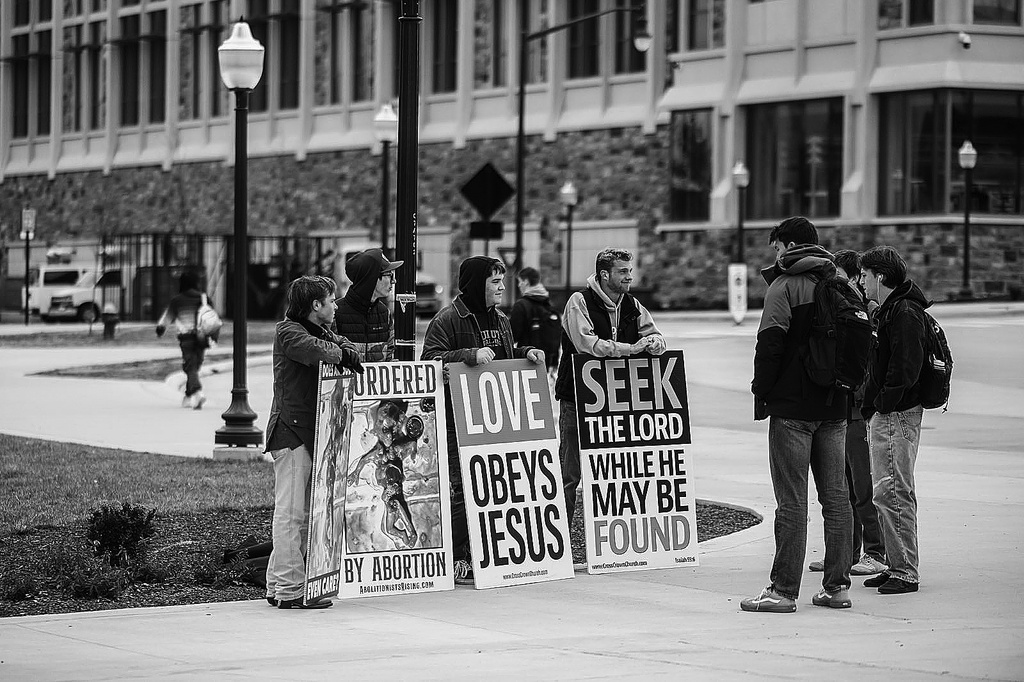
Meet “The Kingsmen,” a cadre of courageous college students who are willing to “take the battle to the gates” in the culture war raging on college campuses.

- Chalcedon Editorial
Each one of us—excluding no one—was once the new generation that those senior to us derided and dismissed as incapable of governing the future. Yet, one of the great traits of youth is a taste for ideas that inspire societal change. Granted, this attribute of the young is easily exploited by leftist ideologies, but there are those who also hunger and thirst after righteousness, and God promised to satisfy their desires.
One such company of young men refer to themselves as “The Kingsmen,” and if any cadre of young Christian soldiers can provide us with hope for the future, it is these courageous college students who are willing to “take the battle to the gates” in the culture war raging on college campuses.
“It is Our Duty to Learn”
Back in October of last year, our own Andrea Schwartz interviewed two college students, Gil Worten and Camden Whitener, who started The Kingsmen on the campus of Virginia Tech. Although it’s encouraging to see bold Christian college students, Gil and Camden are also devouring books and other media on Christian Reconstruction. Why? As Gil said, “God has placed some of the most insightful expositions in our possession. It is our duty to learn from them and continue in this effort.”
After encountering firebrands like Jeff Durbin of Apologia Radio, The Kingsmen were exposed to the deeper theology of Rushdoony, Bahnsen, and North. Jeff Durbin’s effective street apologetics introduced these students first to the idea of presuppositionalism, and then Durbin’s podcast brought them to postmillennialism, theonomy, and ultimately Christian Reconstruction.
We approached Gil Worten again recently to get a bit more detail about his journey and how Christian Reconstruction is shaping a new generation of soldiers for Christ.
Worldview Attracts
What could possibly be so attractive to a generation raised in an age of moral compromise, consumerism, and inundated with competing ideas? Gil said, “What fascinated me about Reconstruction, at first, was not that I understood all the ideas or why they are theologically robust. What I had found was that the men who were drawing on Reconstruction theology had a grasp on the Bible that I did not find elsewhere.” Gil was intrigued by the absolutes of big Christian concepts. He added, “Frankly, their ideas were attractive.”
This was not the way Gil grew up in the faith. He said, “My parents were fiscally conservative and socially progressive. Growing up, we attended a liberal Methodist church that was truly apostate.” Such an environment can either produce compromise, or it can lead to someone becoming hungry for truth. In Gil’s case, it was the latter. “As a babe in Christ, I wanted answers to ethical questions. Many times, I would meet with ministry leaders with questions, and I felt like the answers were extraordinarily shallow.”
With Christian Reconstruction, Gil found the opposite. He discovered the moral certainty of God’s Word and that all things must submit to Christ. He said, “When I looked to Reconstruction on ethics, government, and eschatology, I was finally led through the scriptures for answers. All thoughts were held captive. This was refreshing, and it brought me to see that the deeper you dig, theologically, the more you will find the riches in the scriptures to be innumerable.”
Kingdom Ambassadors
Discovering such Biblical absolutes speaks especially to a young Christian man’s soul because as Gil noted, “Young men want something to fight for and something to fight against. When someone has discovered what we have discovered, how could they waste their time on any other battle? This is where the fight is.”
This is partly why he and his classmates labeled themselves “The Kingsmen.” They saw themselves as “ambassadors of the Kingdom,” not unlike King David’s mighty men. Gil said, “When little Christian boys are raised, they should be told of David’s mighty men, and the awe and inspiration in them must be kindled. They need to be told that they can be greater than David’s mighty men because they serve a greater David, and their weapons for warfare are far stronger.” Gil continued, “Our entire ministry is centered around pressing the crown rights of King Jesus in the public square, equipping others to do so, and teaching about the treasures (laws) of His Kingdom.”
What better opportunity can one ask for than on a college campus filled with students and faculty of every persuasion? Just a glance at the photos included in this article shows how the spiritual battle we’re in is a serious one and how seriously The Kingsmen take it. The fight for the unborn is decades old, but the King calls for a new generation to take up the armor of God in the battle for life.
Equipped for Intellectual Battle
If there’s anything that Christian Reconstruction does well, it’s preparing the faithful to engage in the intellectual and spiritual battles of any age. You probably discovered that yourself, and it’s no different for the upcoming generation. Gil understood this quickly: “When you know that the Bible is the foundation for every intellectual endeavor, the burden is not on us, but on the unbeliever, for providing some foundation for his beliefs.” He continued, “In a campus where many students do not know the difference between a boy and a girl, there is little challenge in having defensible philosophical and theological positions, as long as a little work is put in.”
Christian Reconstruction, Gil noted, “taught us to stand on the word and watch every other sandcastle collapse around us… to be unashamed about any of God’s actions or precepts in scripture, but to always press the antithesis.” This is especially effective when dealing with both students and faculty because it presents an unexpected perspective. Gil said, “Your questions and worldview will be an unforeseen assault on their philosophical high places, which they have never before had challenged.”
The Danger is Always Sin
The modern university can strike fear in the hearts of Christian parents who worry their impressionable children will be driven from the faith during their campus years. Gil addressed this saying, “I have not found college to be any battle whatsoever in terms of belief. The struggle is not belief, but obedience. What leads young people to abandon the faith is not that a good enough argument was presented. From what I can tell, it is the reality that bad company corrupts good morals and that sin is prevalent.”
Dr. Greg Bahnsen used to say that the true motive behind even the most sophisticated atheist argument is really man’s pursuit of autonomy—a way to justify his own sin. It seems Gil’s position is similar. The struggle is obedience, not belief.
Gil does offer the following advice: “The main task… would simply be to find a solid church and to determine whether there are other students who have similar worldviews. Accountability can be a bulwark against all kinds of temptations.”
The Power of God’s Law
The battle against sin becomes easier the more one embraces theonomy, and every family must be aware of the fact that antinomianism strips a student of their ability to sufficiently defend against darkness.
A Christian parent can fear that “God’s law” will drive their children away from God, but the opposite is true if the law is taught the way God revealed it. Gil notes, “It is astonishing to sit back and think about how God gave statutes, precepts, and judgments that are everlasting and contain laws for civil, familial, ecclesiastical, and personal use. God’s law is lacking in nothing (Ps. 19:7). That is unbelievable. How is it possible that Christians could forget about such a breathtaking inheritance?”
God’s law provides the needed purpose that we all require in order to define our respective callings in life, and for Gil, the law provided motivation, not condemnation: “Knowing the beauty of God’s law is one of the things that motivates me most of all to go out and reach as many Christians as I can to discover the work of Reconstruction.”
It’s Inevitable
Something established upon the foundation of Scripture is sure to prevail in history despite the way it’s misunderstood or misapplied. Gil said, “Christian Reconstruction is inevitable; it only depends on whether we will be a people who receive God’s promises and so are instruments for God to work through, or whether we will die without receiving these promises, and a later generation will have to recover what we lost.”
Christian Reconstruction is often misconstrued as a political movement, but as Gil also said, “Christian Reconstruction is just a name for a worldview that affirms the promises and the trajectory of the Kingdom as it is presented in Scripture.” The reason it’s not another conservative political view is because, as Gil noted, “it is comprehensive, and insofar as what was taught corresponds to the Word, these truths will endure forever.” Christian students need a worldview, not a political cause.
Hope for the Future
Such an outlook gives young men like Gil great hope for the future because Christian Reconstruction calls each of us to our godly responsibilities in our own spheres of influence. Gil himself recognizes this when he says, “We have a rich inheritance from the thought of our Theonomic forefathers, and I believe they would find it a shame if we just left all of their formulations alone and called it a day.”
Gil’s intent is to find those who are hungering for something more: “There are Christians who are searching, and they just need someone to tell them where they might look. If God chooses to grant it, my hope would be to grow a network of like-minded Christian families and churches.”
Gil would agree with one of the central objectives of the Chalcedon Foundation since Rush’s passing, which is our emphasis upon publishing as well as embracing the digital era. He said, “We need wiser men for encouragement, insight, and a finger to point us in the right direction. The capacity to rapidly learn about subjects and get access to a plethora of material is readily available to all who know where to look.”
As we’ve said for many years, the greatest influence for Chalcedon, Christian Reconstruction, and the work of R. J. Rushdoony is still ahead of us, and men like Gil are the reason why ministries like Chalcedon, and our resources, will be greatly needed in the years to come.
That’s the kind of vision we like to see—especially from a college student. The work of Christian Reconstruction doesn’t end with the great thinkers or leaders but is rather, as Gil concludes, “the simple acts of faithfulness, such as raising children, loving my future wife, keeping the laws of the covenant, sharing the gospel, and building up others in the faith.”
Please pray for Gil and “The Kingsmen,” and if you’d like to hear Andrea’s Out of the Question Podcast interview with Gil and Camden, visit https://tinyurl.com/OOTQEp359
- Chalcedon Editorial